

Interview
Korea Deep Learning says the bottleneck in AI performance lies in structuring document data
Korea Deep LearningPublished

In an interview for Maeil Ilbo's "Oh Si-nae's Startup Road" on December 11, 2025, Kim Ji-hyun, CEO of Korea Deep Learning, said that the bottleneck in AI performance ultimately lies in structuring document data. Pointing to structural limits that conventional optical character recognition (OCR) has not overcome, Korea Deep Learning predicted that AI that interprets the meaning and hierarchy of documents will change the way businesses and the public sector work.
After DX comes document AX
The interview starts from the distinction between digital transformation (DX) and AI transformation (AX). Once the stage of turning paper into digital files is over, the next task is making those files something AI can understand and use. Korea Deep Learning puts this document AX market at the top of its business priorities.
"If DX stopped at turning paper into PDFs, what will matter from now on is AX, which puts documents into a 'form AI can understand.'"
— Kim Ji-hyun, CEO, Korea Deep Learning
Why conventional OCR, stuck drawing boxes, falls short
Korea Deep Learning sees conventional OCR as a technology stuck in a method of drawing boxes at specific positions in a document and training on them. Because every company designs its contracts, tax invoices and applications differently, a method that has to draw boxes and retrain every time a form changes is hard to apply to real work. In Korea Deep Learning's judgment, a technology that is right only on the documents it was trained on, and has to draw boxes and retrain whenever a new form comes in, can hardly be called automation. It sees real automation as delivering the same performance on documents with different designs, without additional training.
It also saw limits in feeding documents as they are into general-purpose AI. A document is a complex mass of information, like a photo, and putting it in whole produces too many tokens, so important information is easily lost or the answers go off track.
Document structuring has already been proven in the field
Making documents that AI can read is the work of clearing the bottleneck Korea Deep Learning described. In August 2025, Korea Deep Learning took on this problem in the Gyeonggi Provincial Government's generative AI platform project, worth KRW 13.1 billion in total. More than 90% of the Gyeonggi Provincial Government's documents were in unstructured formats such as Hangul (HWP) and PDF, and turning them into structured data was the project's core task.
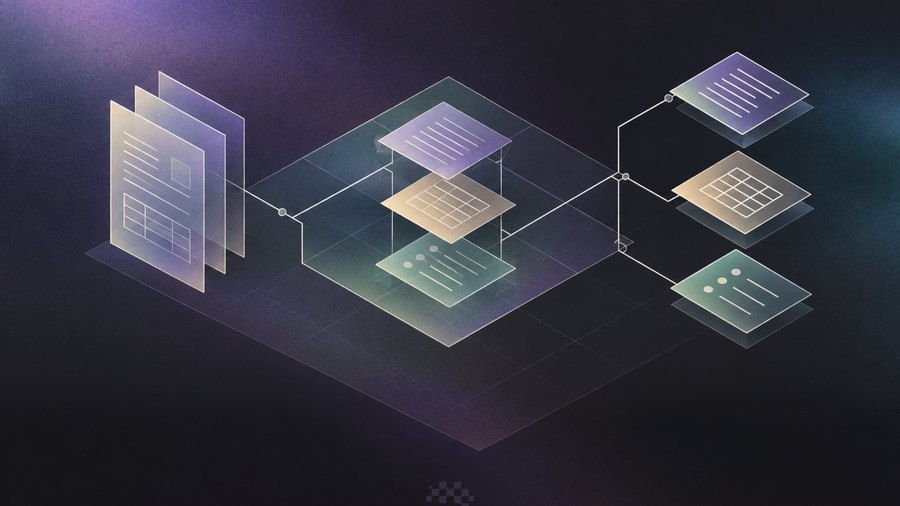
That technology officially launched on October 16, 2025, as DEEP Parser, a document structuring solution. DEEP Parser automatically classifies document elements such as titles, body text, tables, captions and figures into up to 23 types, and converts PDF, HWP and JPEG files into HTML, JSON, Markdown and XML. Working with Wisenut and Konan Technology, it connected this structured data to each company's retrieval-augmented generation (RAG) platform in local government projects, and answers became more accurate and document search faster.
Accuracy over speed, field design over technology
DEEP OCR+, Korea Deep Learning's flagship product, processes documents right away without separate labeling or retraining. Built on its own model trained on a proprietary dataset of more than 400 million images, it supplies solutions to more than 80 customers, including public institutions and large companies. The article introduced a case that cut work processing time by 96% and lowered human error from 15–18% to about 3–4%, and a case at a public institution where the time to enter about 50 application documents by hand fell from one hour to three minutes.
The article also covered on-premises (closed network) deployments for fields where security matters, and the "AI PMO" service, which assigns a technical PM with a master's or doctoral degree to each customer one-on-one. Providing technology alone does not complete automation, Korea Deep Learning explained; the real key to a successful adoption is accurately diagnosing the constraints of each site and designing a structure that can be applied there.
Document structuring will set a nation's productivity
Korea Deep Learning stressed that even as language model technology advances quickly, the bottleneck in AI performance ultimately lies in structuring data. Its outlook is that turning the hierarchy of documents into data AI can understand will determine productivity across the country and its industries. Now in its sixth year since its founding, Korea Deep Learning named its goal as showing overwhelming technical strength in the document AI market.
"I want to build a future where our agents read the world's documents and speed up work, without people even noticing."
— Kim Ji-hyun, CEO, Korea Deep Learning
The full interview was published in Maeil Ilbo.
About DEEP Parser
For AI to work, documents first have to be data. DEEP Parser is a document structuring solution that turns unstructured documents AI struggles to handle directly, such as HWP and PDF, into structured data. It analyzes the meaning and structure of a document together, down to tables, charts, hierarchies and merged cells, to build a knowledge database that RAG and AI agents can use. It was proven in the public sector by structuring administrative documents for the Gyeonggi Provincial Government's generative AI platform, and ranked first overall in the VLM category of ParseBench, a global document parsing benchmark. More information is available on the DEEP Parser page at koreadeep.com.
About Korea Deep Learning
Korea Deep Learning (KDL), founded in 2019, is an enterprise AI agent company. Built on KDL Frontier, its own vision-language model (VLM) specialized for documents, KDL makes AI agents that take on and complete the document work of businesses and public institutions. Its main products are DEEP OCR, DEEP Parser, DEEP Agent and DEEP Ops.