


Press Release
Korea Deep Learning takes first place in ParseBench document parsing with a 1.2-billion-parameter model
Korea Deep LearningPublished
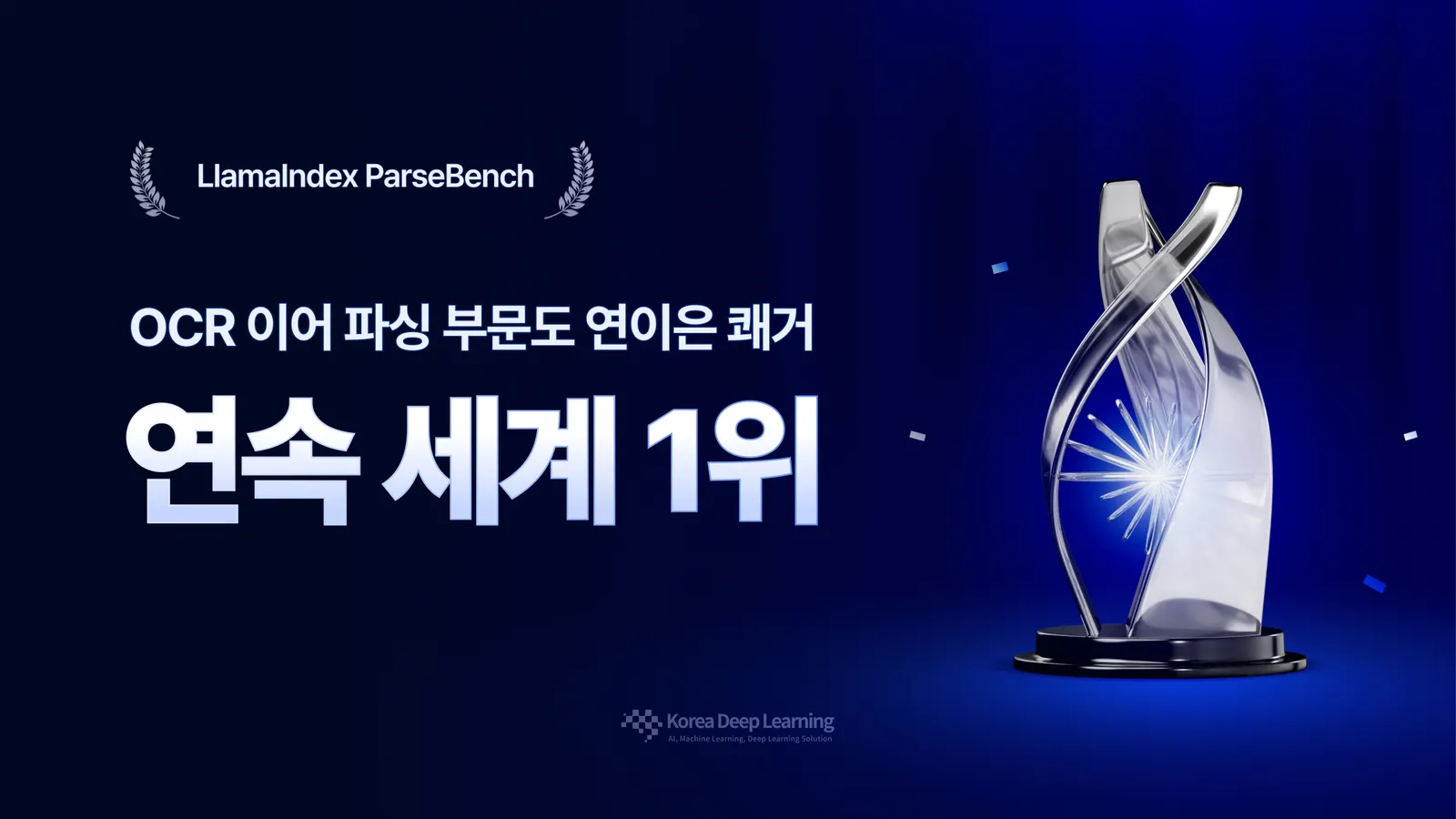
In June 2026, Korea Deep Learning ranked first overall with 76.4 points in the vision-language model (VLM) category of ParseBench, a global document parsing benchmark run by the AI data platform LlamaIndex. It came out ahead of Google Gemini and OpenAI's GPT-5.5 with an ultra-lightweight model of 1.2 billion (1.2B) parameters. Coming after its first place in the English category of OCRBench v2 in March 2026, it was the company's second straight first-place finish.
What ParseBench evaluates
ParseBench is a specialized benchmark that evaluates the document parsing ability of AI models on about 2,000 pages of real enterprise documents from insurance, finance and government. It scores models on five categories, including elements such as tables, layouts and charts that appear often in enterprise documents but are hard for machines to read.
Korea Deep Learning took first place with 76.4 points. Google's Gemini 3 Flash Thinking High was second (75.0 points), and OpenAI's GPT-5.5 third (67.8 points). In the Visual Grounding category, which measures how well a model understands a document's layout, Korea Deep Learning ranked first overall with 78.8 points, about 19 points ahead of the 59.8 that Google Gemini received in the same category.
First place for a single 1.2-billion-parameter model
KDL-Frontier-Parser-nano, the model used in the evaluation, is an ultra-lightweight single model with 1.2 billion parameters. It was trained on more than 400 million images and documents. Because the model is small, it can be installed and run directly in a company's internal environment without external servers, and it is also offered as SaaS. That means it can be used in security-sensitive environments such as finance, insurance and the public sector, where documents are hard to send outside.
Its core strength is Near-Zero Hallucination technology, which minimizes the hallucinations of generative AI. It is designed to analyze a document's layout, the relationships between fields and their positions in space together, so that it does not produce content that is not in the original.
"We are focused on advancing a visual structure perception architecture that lets AI agents decode the complex visual and structural context of documents as intuitively as people do," said Kim Dong-hyun, CSO of Korea Deep Learning.
From the Gyeonggi Provincial Government to Hyundai Capital, AI technology proven first in the field
Korea Deep Learning's technology is being used to restructure administrative data at the Gyeonggi Provincial Government, and it is supplied to more than 80 companies, including Hyundai Capital and LG CNS. Customers that adopted it cut their document processing time by up to 96%.
Earlier, in March 2026, Korea Deep Learning's VLM KDL Frontier ranked first in the English category of OCRBench v2 with 68.1 points. On this benchmark, which evaluates document understanding across 31 scenarios, it led the second-place Gemini 3 Pro Preview by 4.7 points. With this first place in ParseBench, Korea Deep Learning has reached the top of global benchmarks in two areas in a row: text recognition and document parsing. In May 2026, CEO Kim Ji-hyun was also named to the Forbes Asia 30 Under 30 list in the Consumer & Enterprise Technology category.
"This result proves that our architecture is the most practical solution for the era of AI agents."
— Kim Ji-hyun, CEO, Korea Deep Learning
About Korea Deep Learning
Korea Deep Learning (KDL), founded in 2019, is an enterprise AI agent company. Built on KDL Frontier, its own vision-language model (VLM) specialized for documents, KDL makes AI agents that take on and complete the document work of businesses and public institutions. Its main products are DEEP OCR, DEEP Parser, DEEP Agent and DEEP Ops.