

Interview
How Korea Deep Learning moved from OCR that reads documents to an AI agent that understands them
Korea Deep LearningPublished

In an interview with Tech42 published on July 11, 2025, Kim Ji-hyun, CEO of Korea Deep Learning, talked about how the company built an AI agent that goes beyond "recognizing" documents to "understanding" them. The interview focused on how DEEP Agent, launched in March 2025, differs from existing optical character recognition (OCR), and on how Korea Deep Learning, the company behind the technology, has grown.
Why Korea Deep Learning chose technology that is used in the real world
Korea Deep Learning puts solving real problems ahead of theory. It chose vision AI as its business because it judged it to be a technology whose ROI can be calculated in numbers.
Its first business was developing a deep learning-based OCR engine. Adopted for waybill recognition at Korea Post, it brought in the company's first revenue of about KRW 3 million. The company then worked with a kiosk maker to build an unmanned access control system that recognizes ID cards to keep minors out, and when the system was adopted by a support program of the Small Enterprise and Market Service, it led to revenue of about KRW 100 million.
How the data snowball got rolling
Korea Deep Learning's training dataset holds more than 100 million pages. As of the first half of 2025, it holds 13 patents. It used data collected with research consent, data gathered through partners and the pipelines of document generation companies, and in the early days it even trained on documents written by hand. As a result, it recognizes documents that mix tables, handwriting and watermarks with 99% precision and processes 780 pages per minute. The time to adopt AI, which used to take 66 days, has been cut to 10 days. Korea Deep Learning focused on keeping the data snowball rolling and growing it large.
On top of this data, Korea Deep Learning also won outside recognition. In June 2024, it joined NVIDIA Inception, NVIDIA's global startup program, and began receiving the technical support needed for large-scale training and inference. The interview also noted that it had been selected as an elite partner of the program.
Accuracy is a given; now it is about context
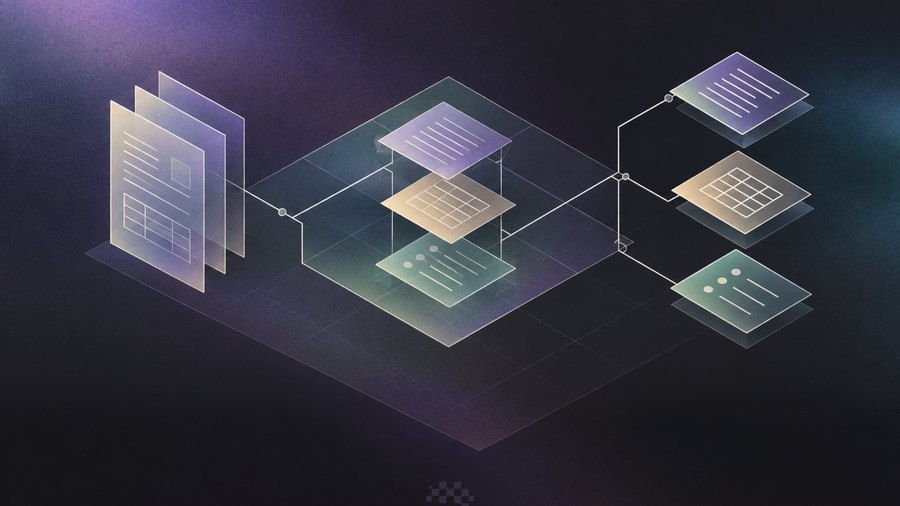
DEEP Agent was at the center of the interview. DEEP Agent does not stop at reading characters and turning them into text. It interprets a document's visual structure and linguistic meaning together to extract the key information, and goes on to carry out the follow-up work. A product that combines DEEP OCR, the document recognition solution, and DEEP Parser, the document structure analysis solution, it takes an uploaded contract from summarizing its key clauses to identifying risky clauses to registering it in ERP. When a document goes in without a template, it grasps the context and pulls out key-value information, and it promises Zero Training, with no prior training needed, Zero Period, with adoption in under 10 days, and Zero Data, with no additional data collection needed. It also has a verification AI feature that automatically checks whether the amounts on contracts and quotes match.
"Accuracy is a given, and reading the context of a document is now becoming more important."
— Kim Ji-hyun, CEO, Korea Deep Learning
Korea Deep Learning explained that DEEP Agent aims for an A2A (agent-to-agent collaboration) structure in which it connects with the AI agents of other large language model (LLM) companies, and it sees the current stage as the starting point of the agent economy. It also noted that LLM developers use DEEP Agent for chunking and structuring work when they build retrieval-augmented generation (RAG).
On April 10, 2025, Korea Deep Learning released DEEP OCR+, Korea's first OCR solution based on a vision-language model (VLM). It is a product on the same path from recognizing documents to understanding them.
Results right after launch and the next goals
The interview also reported that, with this approach of combining OCR with an LLM, 50 contracts were under way within three months of launch. Cumulative orders in the first two months after launch reached KRW 900 million, and Korea Venture Investment Corporation, Hyundai Capital, the National Tax Service and KT were named as contract partners. Its customers number more than 80, including KT, Hyundai, Gyeonggi Province, the National Tax Service and Korea Venture Investment Corporation. It is running a KRW 13 billion project with one LLM company.
Korea Deep Learning has grown on revenue, without investment. It explained the secret as its focus on product-market fit (PMF). Aiming for an initial public offering (IPO) in 2028, it recently began raising investment and gave an IR presentation at the IBK Changgong Demo Day. It is building its team through open recruiting, which looks at the ability to solve real problems rather than degrees or experience, and plans to grow DEEP Agent into an essential solution for LLM companies and to continue its research on the Model Context Protocol (MCP).
The full interview was published in Tech42.
About DEEP Agent
Korea Deep Learning makes AI that does not stop at reading documents. DEEP Agent is a document-based AI agent that interprets a document's visual structure and linguistic meaning together to extract the key information, then carries out the whole of the document work, from classification and verification to the hand-off into business systems. Upload a contract and it summarizes the key clauses, flags the risky ones and goes on to register it in the ERP, and it reaches the field in two weeks on average with no separate training. It holds GS Certification Grade 1, Korea's national software quality certification, and is designated for priority purchase by public institutions. More information is available on the DEEP Agent page at koreadeep.com.
About Korea Deep Learning
Korea Deep Learning (KDL), founded in 2019, is an enterprise AI agent company. Built on KDL Frontier, its own vision-language model (VLM) specialized for documents, KDL makes AI agents that take on and complete the document work of businesses and public institutions. Its main products are DEEP OCR, DEEP Parser, DEEP Agent and DEEP Ops.