

Interview
Korea Deep Learning builds AI that gives people back their time with its 3 ZERO strategy
Korea Deep LearningPublished

In a "Tomorrow's Unicorn" interview with Sisa Journal-e published on May 9, 2025, Kim Ji-hyun, CEO of Korea Deep Learning, said AI should be a work partner that gives people back their time. The article introduced Korea Deep Learning as a "super rookie" that has risen on optical character recognition (OCR) technology built on its own hyperscale vision-language model (VLM), and as a rare bootstrapped AI company that has grown on its own without outside investment. Korea Deep Learning's solutions are used by more than 80 customers, including public institutions and large companies, in finance, manufacturing, retail and healthcare.
A work partner that saves people time
The vision Korea Deep Learning put forward is for AI to take over repetitive, inefficient work and help people focus on more creative and important tasks.
"AI should be a true work partner that saves people time."
— Kim Ji-hyun, CEO, Korea Deep Learning
Korea Deep Learning opened its doors in 2019, when the term "deep learning" was not yet widely used. It saw OCR as stuck at recognizing characters, and judged that AI could interpret the context of documents to make work more efficient.
How DEEP OCR+ reads documents
Korea Deep Learning's core product is DEEP OCR+, a VLM OCR solution built on its own vision-language model. Korea Deep Learning launched the product on April 10, 2025, a month before the interview, as Korea's first VLM-based OCR. Documents without a fixed format, such as contracts and invoices, used to need separate design and labeling for each document, and conventional OCR projects cost hundreds of millions of won and took months to develop. DEEP OCR+ aims to remove this barrier of upfront build costs. The product is offered as an on-premises deployment, SaaS and an API, and was unveiled at World IT Show (WIS) 2025, held from April 24 to 26, 2025.
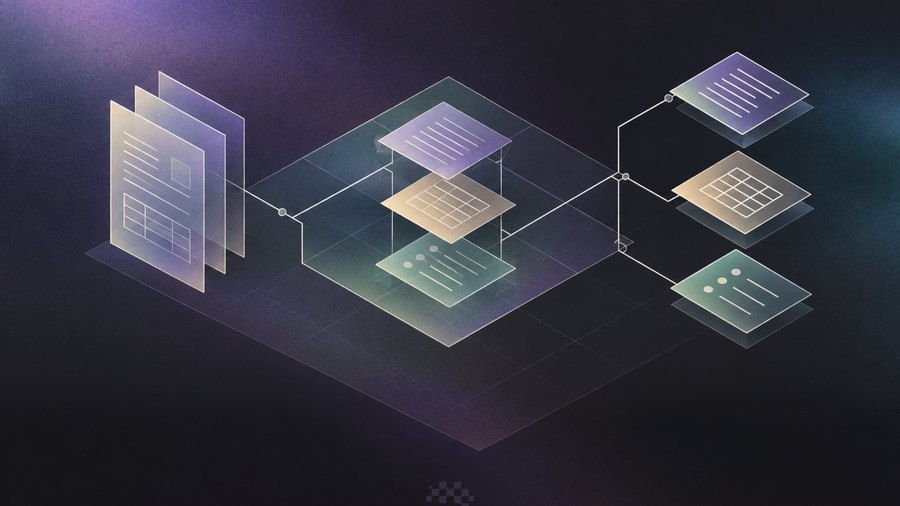
DEEP OCR+ interprets tables, paragraphs, titles, footnotes and the semantic relationships between sentences, and handles unstructured documents, multilingual documents and documents that mix handwriting and tables. It pulls key information out of insurance claims and contracts to summarize risk items, and connects to enterprise resource planning (ERP) and robotic process automation (RPA) systems through a FastAPI-based interface. Korea Deep Learning said it recorded 97 to 99% accuracy in internal benchmarks.
What is the 3 ZERO strategy?
The core strategy is "3 ZERO." ZERO DATA, which needs no collection or labeling of customer data, reduces the need to send sensitive documents outside. It continues a line that began in 2021, when DEEP OCR was unveiled and designed to work even on a company's internal closed network without an internet connection, so that financial and public institutions with strict security requirements could run text recognition without sending data outside. ZERO DEPLOYMENT TIME, which deploys in about two weeks on average with no custom templates, and ZERO TRAINING, which extracts key fields without fine-tuning, follow. It is an approach that lowers customers' costs and raises accuracy.
"Ordinary OCR needs retraining whenever the format changes, but with 'Non-Training AI' we have greatly reduced the upfront cost and preparation."
— Kim Ji-hyun, CEO, Korea Deep Learning
Results from the field were also presented. At a shipbuilding customer that processes 80,000 purchase orders a month, DEEP OCR+ recorded 95.7% key-value mapping accuracy, and an internal review estimated that the staff needed for document entry could be cut from four people to one. For a retail customer, Korea Deep Learning is building a contract processing system that identifies hundreds of clauses and discount and warranty terms by branch, which is expected to cut review time by more than 75% and save about KRW 480 million a year in operating costs.
A hands-on organization that is 70% engineers
About 70% of Korea Deep Learning's organization is engineers. Each project is assigned an AI expert with a master's or doctoral background as a dedicated one-to-one manager. Korea Deep Learning believes it matters to be a hands-on partner that solves customers' problems with them, not one that only provides technology.
Expanding to the US and Japan and preparing to go public
Korea Deep Learning is exploring the US and Japanese markets through local partnerships, and is preparing for an initial public offering by the end of 2027. To that end, it is preparing a global PM structure, MLOps capabilities and the expansion of multilingual models. Korea Deep Learning stressed that, unlike typical AI startups that depend on investment, it has a structure that grows on its own, and said its ultimate goal is to grow into a company that has a positive impact on the world.
The full interview was published in Sisa Journal-e.
About DEEP OCR
Korea Deep Learning started out by reading documents. Built on KDL's own document-specialized VLM, DEEP OCR is Korea's first VLM-based OCR solution, reading not just the characters but the structure and meaning of a document together. It handles unstructured documents in every kind of layout without building separate training data, and extracts text and key-value data from visual elements such as seals, signatures, tables, numbers and symbols. From loan documents in finance to administrative documents in the public sector and handwritten waybills in logistics, documents people used to copy out by hand become business data through DEEP OCR. More information is available on the DEEP OCR page at koreadeep.com.
About Korea Deep Learning
Korea Deep Learning (KDL), founded in 2019, is an enterprise AI agent company. Built on KDL Frontier, its own vision-language model (VLM) specialized for documents, KDL makes AI agents that take on and complete the document work of businesses and public institutions. Its main products are DEEP OCR, DEEP Parser, DEEP Agent and DEEP Ops.