
Interview
Korea Deep Learning looks first at the business flow where budgets are spent, not at the technology
Korea Deep LearningPublished

In an interview in The Electronic Times' "In-sight" series published online on December 8, 2025, Kim Ji-hyun, CEO of Korea Deep Learning, said that an AI business must understand the flow of money in the business before the technology. The interview also ran in print the next day, December 9. Korea Deep Learning makes it a principle to start by looking at where in industry a technology is used and why decision-makers spend budgets on it.
Why do decision-makers spend their budgets?
The first thing Korea Deep Learning raised was a question of perspective. Rather than problems that are academically interesting, it said, one should first look at where in industry a technology is used and why decision-makers spend budgets on it.
Building the structure through internal growth before taking outside capital
Five years after its founding, Korea Deep Learning raised its first venture capital (VC) investment, in the KRW 10 billion range. Until then, it had grown on its own revenue with no outside investment apart from KRW 100 million from TIPS, and along the way it achieved average annual growth of 400%, cumulative revenue of KRW 10 billion and 80 customers. Korea Deep Learning explained that this was the result of its belief that a company should first build its structure through internal growth and only then choose outside capital.
The investment was announced in October 2025 as a Series A round led by Translink Investment, with SV Investment as a major co-investor. On November 27, 2025, the company received a TI-3 rating, in the band for top technology companies, in the technology credit bureau (TCB) assessment for investment by Korea Enterprise Data.
Structuring documents the way a person reads them
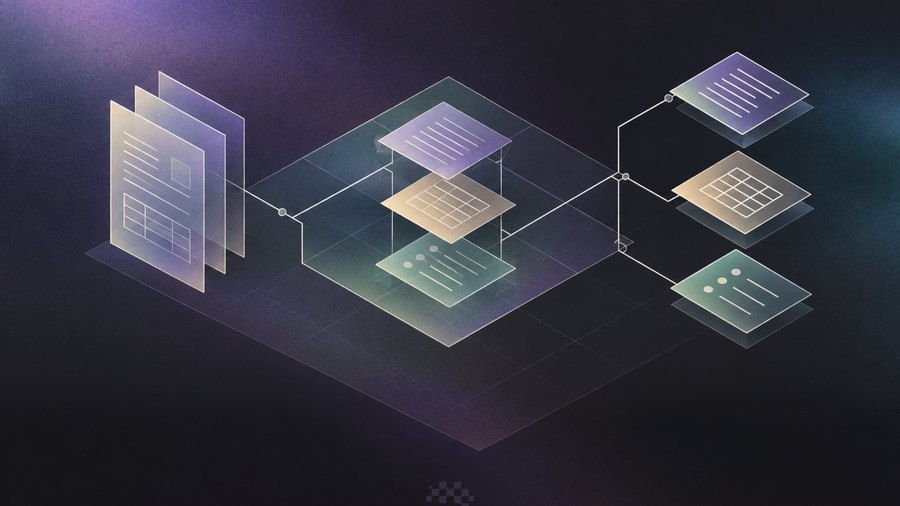
At the heart of its technology is document processing automation based on its own Vision-LLM, refined over five years. Korea Deep Learning proved its technology in the public sector, healthcare and finance by classifying and structuring complex electronic documents and connecting them to search and analysis systems. According to Korea Deep Learning, the core is technology that can structure documents mixing tables, shapes and images the way a person reads them.
This technology came to market as DEEP Agent, the document AI agent launched in March 2025. DEEP Agent interprets a document's visual layout and linguistic meaning together and automates the work that follows. For example, it pulls the key clauses and risks out of a contract, alerts the person in charge, and carries the work through to registering it in an enterprise resource planning (ERP) system. It can be adopted in two weeks on average without separate training, its accuracy is 97 to 99%, and it cuts document processing time by more than 80%. Within two months of launch, it secured contracts worth about KRW 1.1 billion.
Field references become speed and cost
Korea Deep Learning named domain modularization as the source of its competitiveness. It standardizes forms that recur in each industry, such as logistics invoices, financial documents and administrative documents, into modules and optimizes them for each project. The field references it has built up running an OCR business ever since its founding have turned into a competitive edge in speed and cost, it explained.
It explained the spread among customers by the same principle. When it succeeds with one team at a customer, the work often spreads to several teams within the same group.
"The core driver of growth is being put to use right away in the field, more than marketing."
— Kim Ji-hyun, CEO, Korea Deep Learning
Look only at the technology and you lose your way
The interview came back to the question of perspective. Korea Deep Learning warns that clinging to the technology itself makes it easy to lose direction. In its judgment, the way to survive long in the market is to look first at the reason to adopt, the costs that can be cut and the value that can be created.
The full interview appeared in The Electronic Times.
About DEEP Agent
Korea Deep Learning makes AI that does not stop at reading documents. DEEP Agent is a document-based AI agent that interprets a document's visual structure and linguistic meaning together to extract the key information, then carries out the whole of the document work, from classification and verification to the hand-off into business systems. Upload a contract and it summarizes the key clauses, flags the risky ones and goes on to register it in the ERP, and it reaches the field in two weeks on average with no separate training. It holds GS Certification Grade 1, Korea's national software quality certification, and is designated for priority purchase by public institutions. More information is available on the DEEP Agent page at koreadeep.com.
About Korea Deep Learning
Korea Deep Learning (KDL), founded in 2019, is an enterprise AI agent company. Built on KDL Frontier, its own vision-language model (VLM) specialized for documents, KDL makes AI agents that take on and complete the document work of businesses and public institutions. Its main products are DEEP OCR, DEEP Parser, DEEP Agent and DEEP Ops.