

Press Release
Korea Deep Learning selected for Hyundai Capital's company-wide AI-OCR document automation project
Korea Deep LearningPublished

Korea Deep Learning was selected for Hyundai Capital's VLM-based AI-OCR project to automate company-wide document work processes. The project automates, across the company, the classification, recognition and digitization of 46 types of unstructured documents that come with lending, and it marks a case of Korea Deep Learning's document understanding technology being applied to the core work of a major financial company.
Loan underwriting in which people sorted and entered 46 types of documents
Lending at capital finance companies comes with a large volume of documents in widely varying formats, such as agreements, ID cards, business registration certificates and proof of income. The unstructured loan document AI OCR automation project at a major Korean financial company, which Korea Deep Learning announced winning in May 2025, is this Hyundai Capital project, and it covers 46 types of unstructured loan documents.
According to the announcement at the time, the financial company had received a total of 46 types of application and supporting documents as a single PDF during loan underwriting, and people had sorted and entered them by hand. Missing documents, typos and work bottlenecks kept recurring in the process.
DEEP OCR+, which reads a document's structure and context together
The project uses DEEP OCR+, which Korea Deep Learning released on April 10, 2025, as Korea's first VLM-based OCR. DEEP OCR+ is a model specialized for document understanding with a self-training function, designed to keep improving processing accuracy and speed. It analyzes the structure and context of a document together to extract the key information.
The underlying VLM specialized for document understanding was trained on more than 400 million image and text samples accumulated over five years, and can process several document formats at once, including PDF, HWP and Word. Rather than stopping at optical character recognition (OCR), which transcribes characters, the project applies AI that analyzes and judges the meaning of documents to financial work.
Automation from splitting through to RPA integration
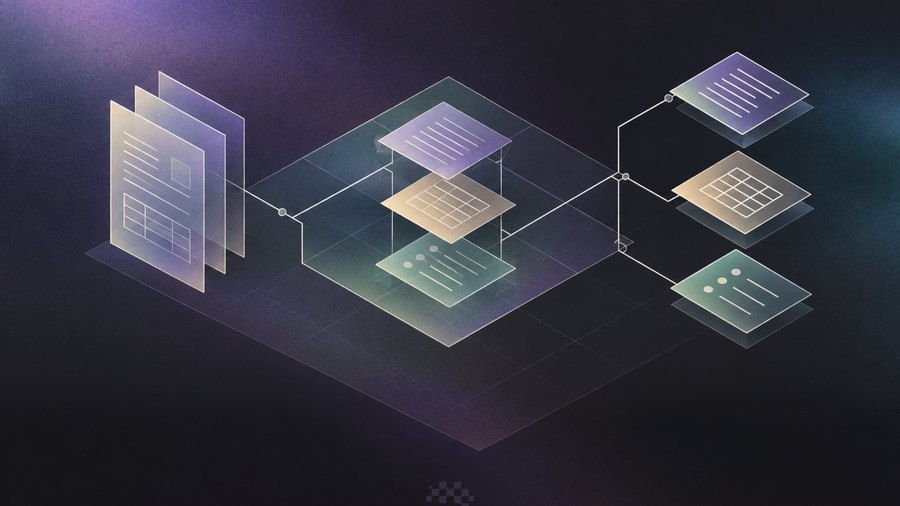
The scope of automation covers every step before and after document processing. The system automatically splits and classifies PDFs in which several documents are merged, then extracts the key data and connects it to the company's internal IT systems. The results can be checked on a real-time verification dashboard, and the system is integrated with robotic process automation (RPA) so the work carries on to the tasks that follow.
"For AI to be adopted across industries, the 'ability to see' has to come first."
— Kim Ji-hyun, CEO, Korea Deep Learning
Korea Deep Learning believes that document understanding technology based on vision intelligence can be applied to a wide range of automation tasks and will become a key factor in speeding up companies' digital transformation. Taking this project as a starting point, Korea Deep Learning plans to extend its technology beyond finance to fields with a lot of document-based work, such as insurance, public institutions and manufacturing. Details such as the project's scope and schedule will be added after confirmation by the company.
DEEP OCR+, adopted right away without data collection or labeling
DEEP OCR+ is Korea Deep Learning's VLM-based OCR solution, demonstrated at AI EXPO KOREA 2025 in May 2025. It processes documents in many forms without separate training, and the company said it can cut document review time by more than 80%. Because it can be used right away without collecting or labeling data, the upfront burden of adoption is low, and it can be applied to unstructured documents, handwriting and documents that mix several languages.
Korea Deep Learning explains that, unlike existing OCR solutions, DEEP OCR+ is a next-generation VLM-based solution that grasps even the meaning and context within a document, and that it has brought upfront adoption costs, which used to run to hundreds of millions of won, close to zero.
About DEEP OCR
Korea Deep Learning started out by reading documents. Built on KDL's own document-specialized VLM, DEEP OCR is Korea's first VLM-based OCR solution, reading not just the characters but the structure and meaning of a document together. It handles unstructured documents in every kind of layout without building separate training data, and extracts text and key-value data from visual elements such as seals, signatures, tables, numbers and symbols. From loan documents in finance to administrative documents in the public sector and handwritten waybills in logistics, documents people used to copy out by hand become business data through DEEP OCR. More information is available on the DEEP OCR page at koreadeep.com.
About Korea Deep Learning
Korea Deep Learning (KDL), founded in 2019, is an enterprise AI agent company. Built on KDL Frontier, its own vision-language model (VLM) specialized for documents, KDL makes AI agents that take on and complete the document work of businesses and public institutions. Its main products are DEEP OCR, DEEP Parser, DEEP Agent and DEEP Ops.