

Press Release
Korea Deep Learning wins the grand prize at the New Gyeonggi Startup Competition, topping 392 teams
Korea Deep LearningPublished
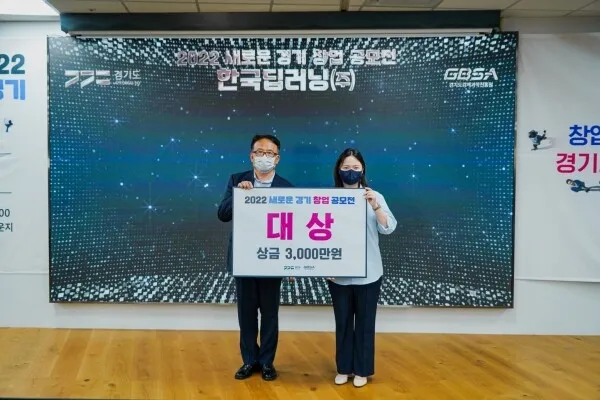
Korea Deep Learning beat 392 teams to win the grand prize at the finals of the 2022 New Gyeonggi Startup Competition, hosted by Gyeonggi Province. Announcing the results of the finals on September 22, 2022, the Gyeonggi Provincial Government said Korea Deep Learning, which was highly rated for innovation, had taken the grand prize. The winning entry was a deep learning-based dual recognition system for shipping information, which immediately rereads the address when a parcel waybill barcode is misread.
The top score among 392 teams
The New Gyeonggi Startup Competition is a contest-style startup support program that Gyeonggi Province runs to discover and develop outstanding prospective and early-stage startups with new ideas. In 2022, a total of 392 teams entered, and 10 teams chosen through first and second preliminary rounds and a main round of judging advanced to the finals to present their startup ideas.
The finals were held on the afternoon of September 21, 2022, at the startup lounge of Gyeonggi Startup Campus in Pangyo. Judging combined the scores of a panel of expert judges with those of a panel of general audience members who took part online, and Korea Deep Learning received the highest score.
Dual recognition that rereads the address when the barcode is missed
In parcel sorting, waybill barcodes sometimes fail to read. Parcels whose barcodes cannot be recognized drop out of the automated sorting line as unsorted items, and people have to check each one again by hand. According to Kim Ji-hyun, CEO of Korea Deep Learning, these unsorted items average at least 20,000 a day and reach as many as 400,000.
When a barcode is misread, the system Korea Deep Learning presented immediately rereads the address at ultra-high speed, keeping misrecognition of handwritten waybills and similar items to a minimum. The idea was well received for its innovation and creativity.
The system applies DEEP OCR, a character recognition technology built on the company's own deep learning engine, to logistics sites. With the same technology, Korea Deep Learning won the Korea Economic Daily President's Award at the 2022 Korea Impactech Awards in April 2022. It has built up waybill recognition technology in logistics, including being selected for the AI Voucher Support Program with Sunghwa Corporate Express in 2022 to develop a handwritten waybill recognition system, and it has also run a pilot project with Korea Post.
KRW 30 million in prize money and extra points for startup support
The grand prize winner receives KRW 30 million in prize money and a certificate. Winning companies also receive benefits such as extra points when applying for Gyeonggi Province's startup support programs and facilities, and special guarantees. The total prize money for the competition is KRW 115 million.
"As the 8th popularly elected administration has pledged to make Gyeonggi Province a paradise for startups, we will provide tailored support to lay the groundwork for innovative startups to build successful businesses," said Kim Pyeong-won, Director of the Startup Support Division at the Gyeonggi Provincial Government.
About DEEP OCR
Korea Deep Learning started out by reading documents. Built on KDL's own document-specialized VLM, DEEP OCR is Korea's first VLM-based OCR solution, reading not just the characters but the structure and meaning of a document together. It handles unstructured documents in every kind of layout without building separate training data, and extracts text and key-value data from visual elements such as seals, signatures, tables, numbers and symbols. From loan documents in finance to administrative documents in the public sector and handwritten waybills in logistics, documents people used to copy out by hand become business data through DEEP OCR. More information is available on the DEEP OCR page at koreadeep.com.
About Korea Deep Learning
Korea Deep Learning (KDL), founded in 2019, is an enterprise AI agent company. Built on KDL Frontier, its own vision-language model (VLM) specialized for documents, KDL makes AI agents that take on and complete the document work of businesses and public institutions. Its main products are DEEP OCR, DEEP Parser, DEEP Agent and DEEP Ops.