

Press Release
Korea Deep Learning demonstrates DEEP Parser live at Gyeonggi Province's generative AI demo day
Korea Deep LearningPublished
On November 12, 2025, Korea Deep Learning took part in the Gyeonggi Generative AI Platform Demo Day at the Gyeonggi Provincial Government and gave a live demonstration of DEEP Parser, its VLM-based document structure analysis solution. Turning documents that visitors brought into structured data on the spot, the company showed the role DEEP Parser plays in Gyeonggi Province's KRW 13.1 billion generative AI platform project.
Presenting the results of a KRW 13.1 billion project
The demo day presented the results of the KRW 13.1 billion generative AI platform project led by Gyeonggi Province. It was attended by the Vice Governor for Economic Affairs, members of the provincial assembly, and people from leading AI startups.
Gyeonggi Province's generative AI platform project is the first among Korea's provincial-level governments to bring generative AI into its administrative work across the board. Over about 11 months, it is building an AI-based work system that supports day-to-day administration such as document drafting, meeting management and information search. In August 2025, Korea Deep Learning supplied DEEP Parser to the project in cooperation with MTDATA, a company specializing in AI, big data and cloud.
Visitors' documents became data on the spot
At its consultation booth, Korea Deep Learning let visitors upload the documents or sample data they wanted and see the structured results right away. It showed on site exactly how documents that mix tables, charts, hierarchies and merged cells turn into data.
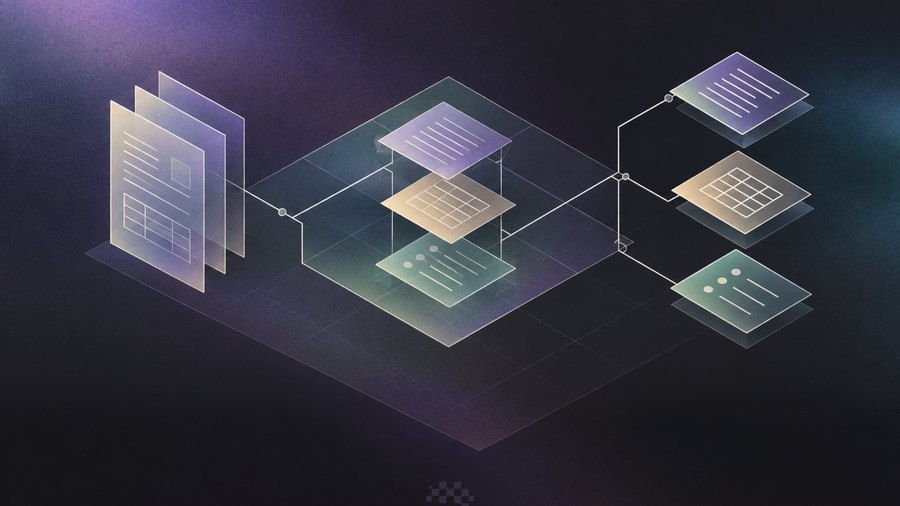
Conventional OCR stopped at extracting text from documents. DEEP Parser uses VLM technology to analyze the meaning and structure of a document as well. Officially launched in October 2025, it automatically classifies document elements such as titles, body text, tables, captions and figures into up to 23 types, and converts PDF, HWP and JPEG files into HTML, JSON, Markdown and XML. Because it is built on the company's own VLM, it can process a wide range of documents immediately without separately preparing training data.
HWP and PDF make up more than 90% of the provincial government's documents
In the Gyeonggi Provincial Government project, DEEP Parser's role is to create the underlying data. More than 90% of the provincial government's documents are unstructured documents such as HWP and PDF files, which generative AI has difficulty using as they are. DEEP Parser turns these documents into structured data that AI can use, laying the groundwork for extracting information from policy documents and reports, summarizing meeting minutes, and document search and question-answering services for public officials.
In the company's internal tests, DEEP Parser recorded 97.3% accuracy in recognizing document elements and 96% accuracy in extracting data.
Kim Ji-hyun, CEO of Korea Deep Learning, said it was meaningful to be able to show directly at the demo day how the solution is used in real public administration.
"Starting with the Gyeonggi Provincial Government, we will continue to expand the supply of our solution to local governments and public institutions across the country."
— Kim Ji-hyun, CEO, Korea Deep Learning
Document structuring that works right away, without separate training
Behind DEEP Parser is the company's own VLM, built on the large volume of text and image training data Korea Deep Learning has accumulated over five years. Even when a new type of document comes in, it can be processed right away without separately collecting or labeling data, so public institutions face almost no upfront burden when they adopt it. This structure is also what let the company process visitors' documents on the spot at the demo day.
With the demo day, Korea Deep Learning presented interim results from the project about three months after announcing the supply deal in August 2025. The Gyeonggi Provincial Government's generative AI platform is being built over about 11 months, and throughout that process DEEP Parser will continue to turn administrative documents into data that AI can read.
About DEEP Parser
For AI to work, documents first have to be data. DEEP Parser is a document structuring solution that turns unstructured documents AI struggles to handle directly, such as HWP and PDF, into structured data. It analyzes the meaning and structure of a document together, down to tables, charts, hierarchies and merged cells, to build a knowledge database that RAG and AI agents can use. It was proven in the public sector by structuring administrative documents for the Gyeonggi Provincial Government's generative AI platform, and ranked first overall in the VLM category of ParseBench, a global document parsing benchmark. More information is available on the DEEP Parser page at koreadeep.com.
About Korea Deep Learning
Korea Deep Learning (KDL), founded in 2019, is an enterprise AI agent company. Built on KDL Frontier, its own vision-language model (VLM) specialized for documents, KDL makes AI agents that take on and complete the document work of businesses and public institutions. Its main products are DEEP OCR, DEEP Parser, DEEP Agent and DEEP Ops.