

Press Release
Korea Deep Learning supplies DEEP Parser to the Gyeonggi Provincial Government's KRW 13.1 billion generative AI platform
Korea Deep LearningPublished
On August 26, 2025, Korea Deep Learning supplied DEEP Parser, its vision-language model (VLM)-based document structure analysis solution, to the Gyeonggi Provincial Government's "2025 Generative AI Platform Construction Project." With more than 90% of the provincial government's documents in unstructured formats such as HWP and PDF, turning them into data that generative AI can read was the project's first task, and DEEP Parser took on that role. The project is being carried out in partnership with MTDATA, a company specializing in AI, big data and cloud.
KRW 13.1 billion, and the first provincial-level government to bring generative AI into all of its administrative work
The KRW 13.1 billion project is the first case among Korea's provincial-level local governments of bringing generative AI fully into administrative work as a whole. Over about 11 months, the Gyeonggi Provincial Government will set up a practical AI work support system for tasks such as document writing, meeting management and information search.
Bringing generative AI into administrative work first requires data that AI can read. Turning unstructured documents into structured data is the project's core task, and DEEP Parser precisely digitizes administrative documents and policy materials to create the base data for the AI work support system.
How DEEP Parser reads even tables and merged cells
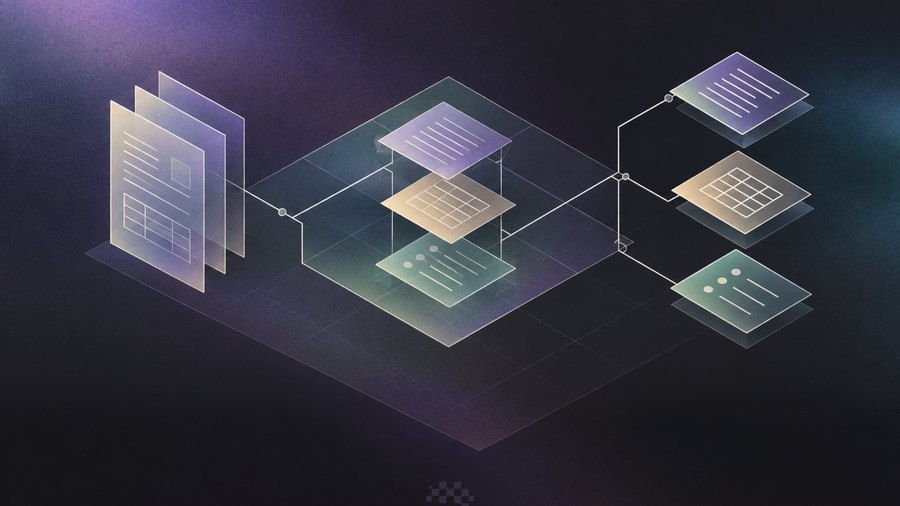
Conventional OCR stopped at pulling text out of documents. DEEP Parser uses VLM technology to analyze a document's meaning and structure at the same time, precisely recognizing even complex elements such as tables, charts, hierarchies and merged cells.
It is built on Korea Deep Learning's own VLM, trained on large volumes of text and image data the company has accumulated over five years. It can process many types of documents immediately, without separate data collection or labeling, so there is almost no initial burden of adoption. In internal tests, it recorded 97.3% accuracy in recognizing document fields and 96% accuracy in extracting data.
Four AI work support functions for the Gyeonggi Provincial Government
With DEEP Parser, the Gyeonggi Provincial Government will be able to implement precise digitization and structuring of unstructured documents, extraction and refinement of information from policy documents and reports, summaries of meeting minutes with automatic extraction of key points, and document-based search and question-answering services for public officials. Many stages of administrative work, from writing documents to searching for information, will run on structured document data.
"DEEP Parser is a core technology for building a knowledge database that lets AI understand and use documents."
— Kim Ji-hyun, CEO, Korea Deep Learning
Korea Deep Learning said it was meaningful to contribute to the digital transformation of the public sector through the Gyeonggi Provincial Government's generative AI platform project, and that it will continue to contribute to advancing the generative AI ecosystem.
The answers of generative AI come from document data
Generative AI mostly helps with administrative work by finding and reading the documents an institution holds and then producing an answer. If those documents go in only as text with broken tables and forms, the AI produces answers while missing the basis of the figures and the relationships between fields. This is why document structuring is seen as the first step in building a generative AI platform.
In this project, Korea Deep Learning and MTDATA will turn the HWP and PDF documents the Gyeonggi Provincial Government has accumulated into structured knowledge data, laying the foundation on which the document writing, meeting management and information search functions run.
This is not the company's first tie with Gyeonggi Province. At the Gyeonggi Province Promising SME certification ceremony on October 29, 2024, Korea Deep Learning was selected as a promising SME in the startup category. Starting with this project, Korea Deep Learning plans to meet the demand for document AI in the public sector.
About DEEP Parser
For AI to work, documents first have to be data. DEEP Parser is a document structuring solution that turns unstructured documents AI struggles to handle directly, such as HWP and PDF, into structured data. It analyzes the meaning and structure of a document together, down to tables, charts, hierarchies and merged cells, to build a knowledge database that RAG and AI agents can use. It was proven in the public sector by structuring administrative documents for the Gyeonggi Provincial Government's generative AI platform, and ranked first overall in the VLM category of ParseBench, a global document parsing benchmark. More information is available on the DEEP Parser page at koreadeep.com.
About Korea Deep Learning
Korea Deep Learning (KDL), founded in 2019, is an enterprise AI agent company. Built on KDL Frontier, its own vision-language model (VLM) specialized for documents, KDL makes AI agents that take on and complete the document work of businesses and public institutions. Its main products are DEEP OCR, DEEP Parser, DEEP Agent and DEEP Ops.