

Press Release
Korea Deep Learning launches DEEP Parser, which turns HWP and PDF files into AI-ready data
Korea Deep LearningPublished
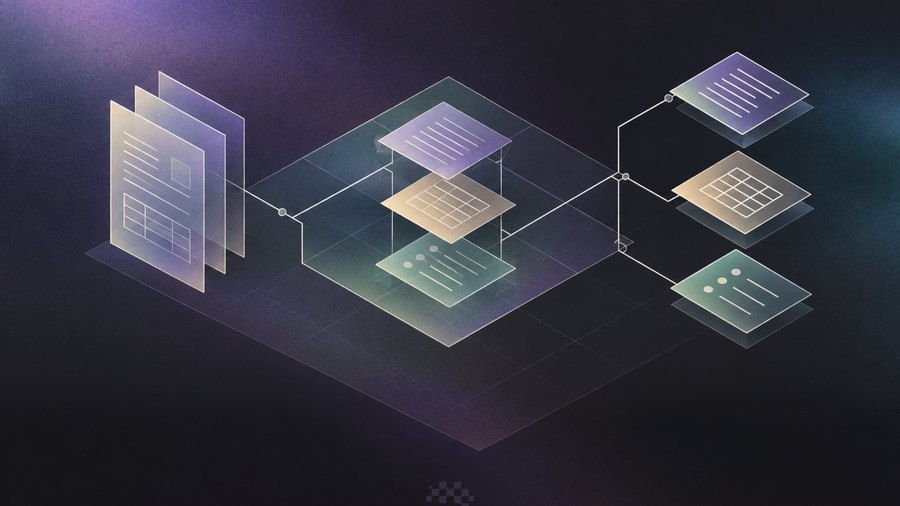
On October 16, 2025, Korea Deep Learning officially launched DEEP Parser, a document structuring solution that turns unstructured documents such as HWP and PDF files into structured data that can be used for large language model (LLM) training and search. The vision-language model (VLM)-based product automatically classifies document elements such as titles, body text, tables, captions and figures into up to 23 types.
Turning documents into something AI can read
Most of the knowledge held by businesses and institutions sits in documents such as Hangul (HWP) and PDF files, but AI has a hard time handling them as they are. When documents that mix tables, charts, hierarchies and merged cells are extracted only as characters, the context breaks, and the quality of answers from retrieval-augmented generation (RAG) and AI agents drops.
DEEP Parser uses VLM technology to analyze a document's meaning and structure together. It automatically classifies document elements into up to 23 types and converts PDF, HWP and JPEG files into HTML, JSON, Markdown and XML. Large documents are automatically split into units of meaning that AI can handle well, greatly reducing the time spent on data preprocessing. It can also process a wide range of documents right away, without preparing separate training data.
Optional modules and an API for faster adoption
Complex table recognition, image analysis and personal data protection are offered as optional modules. To speed the move from proof of concept (PoC) to commercial use, the package lineup was simplified, and API integration is supported so it can connect to existing in-house systems such as enterprise resource planning (ERP) and robotic process automation (RPA). A web-based online demo is also available, letting companies upload their own documents and check the structuring results themselves. Demo links are sent in turn to companies that apply in advance.
Technology first proven in a KRW 13.1 billion Gyeonggi Provincial Government project
DEEP Parser was proven first in the public sector. In August 2025, working with MTDATA, Korea Deep Learning supplied the technology to the Gyeonggi Provincial Government's KRW 13.1 billion "2025 Generative AI Platform Construction Project." With more than 90% of the provincial government's documents in unstructured formats such as HWP and PDF, turning them into data AI can read was the project's core task, and in internal tests the technology recorded 97.3% accuracy in recognizing document fields and 96% accuracy in extracting data.
Korea Deep Learning has also set up partnerships with Wisenut and Konan Technology. In local government projects, the structured data produced by DEEP Parser was linked with each company's RAG and search platforms, and verification confirmed that answers to user questions became more accurate and document search became faster.
A product lineup that runs from OCR to parser to agent
With this launch, Korea Deep Learning's document AI lineup is complete, running from DEEP OCR (recognition) to DEEP Parser (structuring) to DEEP Agent (doing the work). After releasing DEEP Agent, a document-based AI agent, in March 2025, and DEEP OCR+, Korea's first VLM-based OCR solution, in April 2025, Korea Deep Learning has now turned document structuring into a product as well.
"Building on our integration with Wisenut and Konan Technology, we will widen our ties across the ecosystem and, by offering our API and demo, help enterprise customers get results they can feel right away."
— Kim Ji-hyun, CEO, Korea Deep Learning
About DEEP Parser
For AI to work, documents first have to be data. DEEP Parser is a document structuring solution that turns unstructured documents AI struggles to handle directly, such as HWP and PDF, into structured data. It analyzes the meaning and structure of a document together, down to tables, charts, hierarchies and merged cells, to build a knowledge database that RAG and AI agents can use. It was proven in the public sector by structuring administrative documents for the Gyeonggi Provincial Government's generative AI platform, and ranked first overall in the VLM category of ParseBench, a global document parsing benchmark. More information is available on the DEEP Parser page at koreadeep.com.
About Korea Deep Learning
Korea Deep Learning (KDL), founded in 2019, is an enterprise AI agent company. Built on KDL Frontier, its own vision-language model (VLM) specialized for documents, KDL makes AI agents that take on and complete the document work of businesses and public institutions. Its main products are DEEP OCR, DEEP Parser, DEEP Agent and DEEP Ops.