

Press Release
Korea Deep Learning launches DEEP OCR+, Korea's first VLM-based OCR
Korea Deep LearningPublished
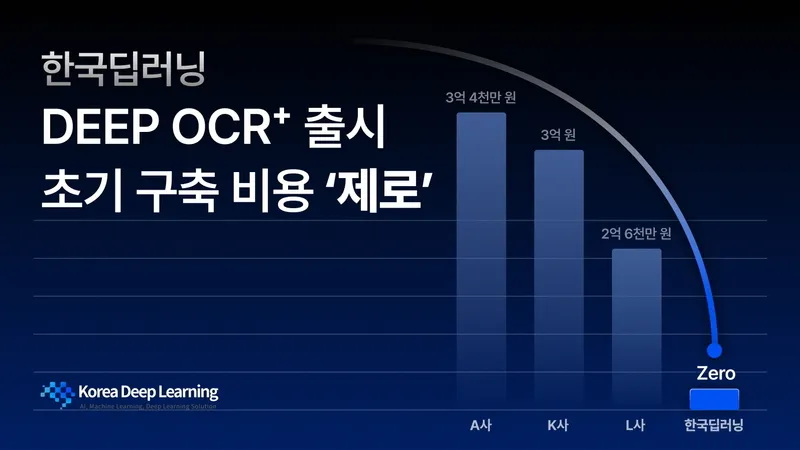
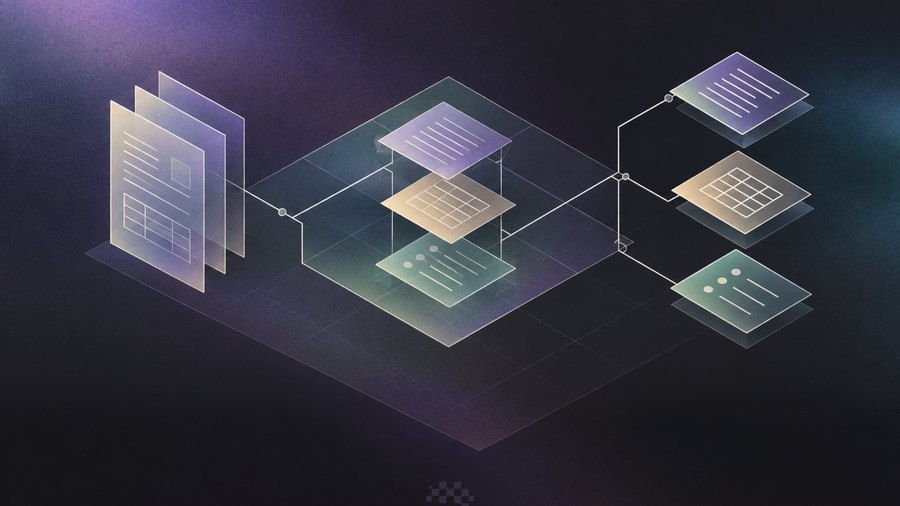
On April 10, 2025, Korea Deep Learning launched DEEP OCR+, Korea's first optical character recognition (OCR) solution based on a vision-language model (VLM). Unlike conventional OCR, which pulls characters out of document images, DEEP OCR+ is designed to analyze the meaning and structure of a document automatically and extract the key information. The goal of the launch is to remove the barrier of initial build costs that used to run to hundreds of millions of won.
Conventional OCR that stopped at tables and clauses
Conventional OCR stopped at extracting text from document images, so it struggled to recognize complex structures such as tables, clauses and paragraphs. Documents without a fixed format, such as contracts and invoices, needed their own design and labeling for each document, and the cost of deploying and maintaining them was high to match. Conventional OCR projects required costs in the hundreds of millions of won and months of development.
In an interview with ZDNet Korea in February 2025, Korea Deep Learning said it would make OCR the core of business automation rather than a technology that simply recognizes documents. DEEP OCR+ is the first product to carry that direction.
A VLM trained on 400 million pages
DEEP OCR+ is built on Korea Deep Learning's own VLM, trained over five years on more than 400 million pages of text and image documents. It processes images and text together without depending on a particular format, and structures and organizes the main information even from unstructured documents in varied formats without separate training.
Korea Deep Learning explained that interest has been growing in AI technology that goes beyond simple recognition to grasp the meaning and context within documents. The company said the new product would be an example of how document processing technology is evolving within this trend.
DEEP OCR+ pulls out everything from contract terms to risk clauses
The uses are concrete. Feed in a contract and it extracts dates, amounts and key clauses, and shows a summary of items that could pose a risk. It also handles documents that mix Korean, English, numbers and special characters, as well as complex table and paragraph structures. Results can be exported to formats such as JSON and Excel, making them easy to connect to enterprise systems such as RPA and ERP, and cutting the time spent reviewing and entering documents leads to business automation.
Deployment in two weeks on average, with on-premises, SaaS and API options
Korea Deep Learning explained that DEEP OCR+ can handle a wide range of document types right away without separate data collection or labeling, so there is almost no initial deployment burden. It delivers high accuracy with only a minimal amount of customer data. The average deployment period is around two weeks. The product is offered on-premises, as SaaS and as an API.
About DEEP OCR
Korea Deep Learning started out by reading documents. Built on KDL's own document-specialized VLM, DEEP OCR is Korea's first VLM-based OCR solution, reading not just the characters but the structure and meaning of a document together. It handles unstructured documents in every kind of layout without building separate training data, and extracts text and key-value data from visual elements such as seals, signatures, tables, numbers and symbols. From loan documents in finance to administrative documents in the public sector and handwritten waybills in logistics, documents people used to copy out by hand become business data through DEEP OCR. More information is available on the DEEP OCR page at koreadeep.com.
About Korea Deep Learning
Korea Deep Learning (KDL), founded in 2019, is an enterprise AI agent company. Built on KDL Frontier, its own vision-language model (VLM) specialized for documents, KDL makes AI agents that take on and complete the document work of businesses and public institutions. Its main products are DEEP OCR, DEEP Parser, DEEP Agent and DEEP Ops.