

Press Release
Korea Deep Learning opens DEEP Agent Lab, where businesses test OCR and parser performance on their own documents
Korea Deep LearningPublished
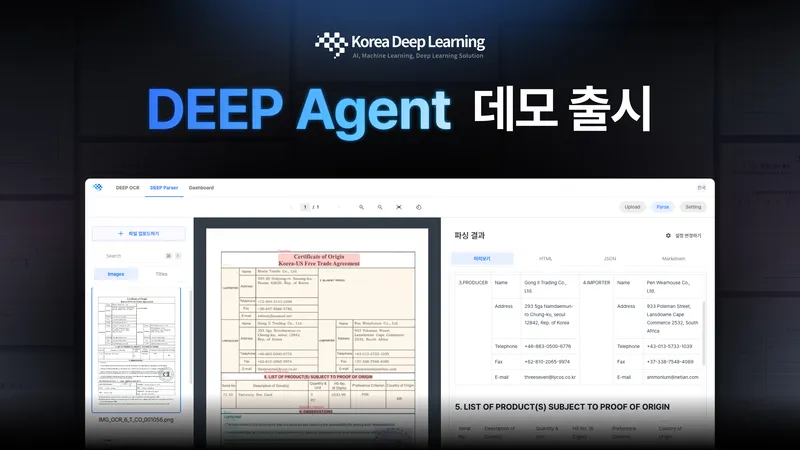
On December 16, 2025, Korea Deep Learning officially launched DEEP Agent Lab, a demo platform where businesses can try its document AI solution DEEP Agent for themselves before adopting it. Businesses can upload their own documents and check the real processing quality of DEEP OCR and DEEP Parser. The idea behind the launch is to let them verify performance on their own documents, not on the numbers in sales materials.
Test OCR and the parser separately on your own documents
DEEP Agent, Korea Deep Learning's document AI launched in March 2025, is made up of DEEP OCR and DEEP Parser, and each of the two functions can run on its own. In DEEP Agent Lab, too, users upload a document and check the OCR and parser results separately.
DEEP OCR provides table detection, text extraction and coordinate information, and DEEP Parser provides document structure decomposition and field extraction. Users can upload PDFs, JPG and PNG scans, photographed images and some office documents. DEEP OCR results can be downloaded as HTML, JSON, CSV, Excel and PDF, and DEEP Parser results as JSON, HTML and PDF. The on-premises and API versions run on engines that work the same way, so the quality seen in the demo carries straight over to the real deployment environment.
"DEEP Agent Lab is a platform where you can try OCR and the parser each on their own, so businesses can check the processing quality of document-based AI before they adopt it."
— Kim Ji-hyun, CEO, Korea Deep Learning
Credit-based login and enterprise SSO support
The platform runs on login, and users use its functions within the credits assigned to their personal or business accounts. It supports Google login, so it can also work in enterprise SSO environments, and a dashboard shows usage by user and by team, remaining credits and analysis history.
The results are designed to carry through to the work. DEEP OCR results can be connected to enterprise resource planning (ERP), robotic process automation (RPA) and customer relationship management (CRM) systems, and DEEP Parser results can be used for automated document verification, report generation, and search based on large language models (LLMs) and retrieval-augmented generation (RAG).
Search and RAG uses that came out of experiments with Wisenut and Konan Technology
DEEP Agent Lab was built on experiments carried out with Wisenut and Konan Technology. The three companies applied data extracted with DEEP Agent to search and RAG systems and confirmed improvements in document search accuracy, response stability and the quality of field-based question answering. The work extends a collaboration in which structured data produced by DEEP Parser, officially launched in October 2025, was connected to the two companies' search and RAG platforms. Korea Deep Learning plans to extend this to search and question-answering systems for specific industries.
Industry packages for finance, the public sector, manufacturing and logistics
Along with the launch, Korea Deep Learning also unveiled document AI packages for major industries including finance, the public sector, manufacturing and logistics. The packages contain data structures, rule sets, evaluation data and API templates, shortening the time from proof of concept (PoC) to commercial adoption. "Through industry packages, APIs and on-premises delivery, we will speed up the adoption of document automation," said Kim Ji-hyun, CEO of Korea Deep Learning.
About DEEP OCR
Korea Deep Learning started out by reading documents. Built on KDL's own document-specialized VLM, DEEP OCR is Korea's first VLM-based OCR solution, reading not just the characters but the structure and meaning of a document together. It handles unstructured documents in every kind of layout without building separate training data, and extracts text and key-value data from visual elements such as seals, signatures, tables, numbers and symbols. From loan documents in finance to administrative documents in the public sector and handwritten waybills in logistics, documents people used to copy out by hand become business data through DEEP OCR. More information is available on the DEEP OCR page at koreadeep.com.
About DEEP Parser
For AI to work, documents first have to be data. DEEP Parser is a document structuring solution that turns unstructured documents AI struggles to handle directly, such as HWP and PDF, into structured data. It analyzes the meaning and structure of a document together, down to tables, charts, hierarchies and merged cells, to build a knowledge database that RAG and AI agents can use. It was proven in the public sector by structuring administrative documents for the Gyeonggi Provincial Government's generative AI platform, and ranked first overall in the VLM category of ParseBench, a global document parsing benchmark. More information is available on the DEEP Parser page at koreadeep.com.
About DEEP Agent
Korea Deep Learning makes AI that does not stop at reading documents. DEEP Agent is a document-based AI agent that interprets a document's visual structure and linguistic meaning together to extract the key information, then carries out the whole of the document work, from classification and verification to the hand-off into business systems. Upload a contract and it summarizes the key clauses, flags the risky ones and goes on to register it in the ERP, and it reaches the field in two weeks on average with no separate training. It holds GS Certification Grade 1, Korea's national software quality certification, and is designated for priority purchase by public institutions. More information is available on the DEEP Agent page at koreadeep.com.
About Korea Deep Learning
Korea Deep Learning (KDL), founded in 2019, is an enterprise AI agent company. Built on KDL Frontier, its own vision-language model (VLM) specialized for documents, KDL makes AI agents that take on and complete the document work of businesses and public institutions. Its main products are DEEP OCR, DEEP Parser, DEEP Agent and DEEP Ops.