
Press Release
Korea Deep Learning builds 5,000 multi-angle CCTV public safety data items
Korea Deep LearningPublished
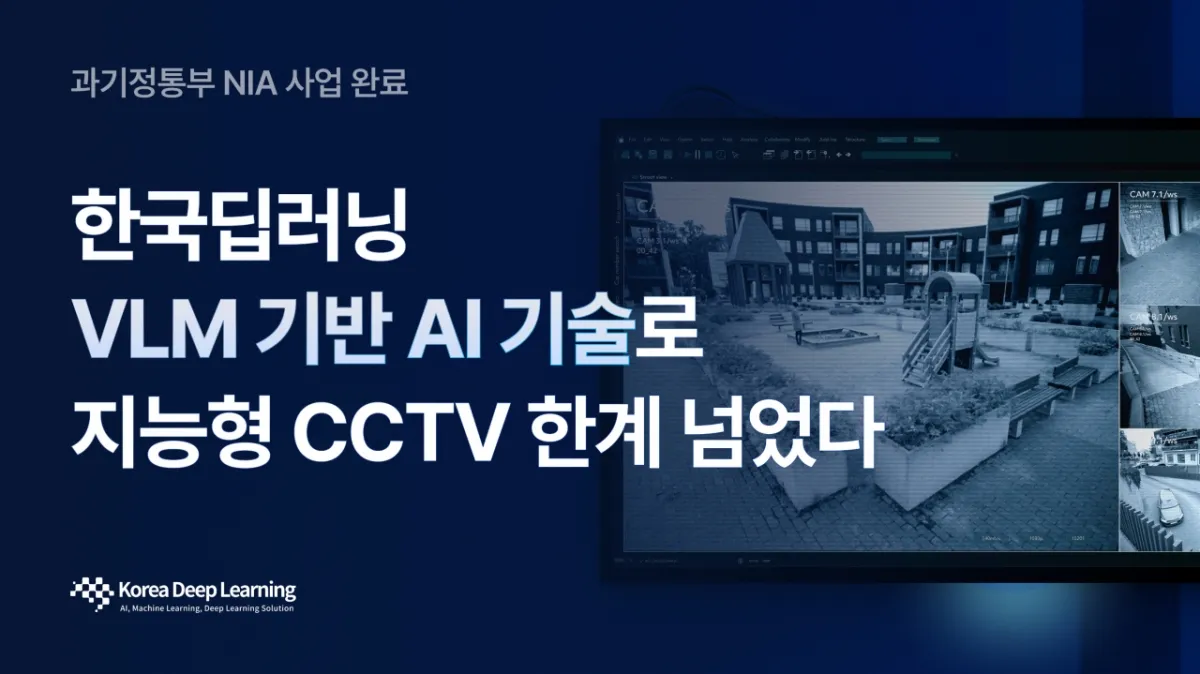
In February 2026, Korea Deep Learning built 5,000 items of multi-angle CCTV public safety data for training vision-language models (VLMs). The data links CCTV footage shot from multiple angles to capture the context before, during and after an incident, and the work was carried out with support from the 2025 Hyperscale AI Ecosystem Building Project of the Ministry of Science and ICT and the National Information Society Agency (NIA). Korea Deep Learning led the project, Kudo Communication took part, and Bucheon City cooperated.
Seeing past the view of a single camera
CCTV installations are growing nationwide, but existing intelligent CCTV was designed around footage shot from one direction and object labeling, so it could only recognize situations in fragments. It struggled to understand the context of an incident, follow situations that change continuously, detect several objects at once, or recognize actions when the view was blocked.
The project aims to create a dataset that links CCTV footage shot from multiple angles so the context of an incident can be analyzed. The work lays the training foundation for intelligent monitoring that goes beyond recognizing objects on screen to reasoning about the situation.
"We built next-generation CCTV training data that goes beyond simple object detection to understand the context and flow of a situation."
— Kim Ji-hyun, CEO, Korea Deep Learning
Eleven public safety situations, before, during and after
The data has a time-series structure that tracks the flow before, during and after an incident. It captures multi-angle scenes together to reduce blind spots, and includes object class IDs, camera positions and frame-by-frame evidence. Raw data and processed data for 11 public safety situations, such as perimeter intrusion and prolonged loitering in a specific area, total 5,000 items.
The roles were divided. Kudo Communication secured Bucheon City as the client institution and led the installation of additional multi-angle CCTV cameras to collect data from real public safety scenarios. Korea Deep Learning handled data processing and quality control, organizing the data into a form ready for training. It also developed its own chain-of-thought (CoT) labeling authoring tool, which captures step-by-step logical reasoning, to advance its labeling system.
From pseudonymized data review to 100% in external verification
A personal information protection system was applied as well. The data went through an adequacy review by the pseudonymized information processing committee, and sensitive information such as faces, shop signs and license plate numbers was de-identified.
Quality verification was carried out both internally and externally. In the company's own validity tests using the latest AI video analysis models, the data scored 100% with no verification errors in diversity, syntactic accuracy, semantic accuracy and reasoning validity. In NIA's external verification, the data was also rated 100% in quality and received an "Excellent" rating, and the company earned NIA's mark confirming it as a participant in spreading AI ethics.
The second video understanding project, following the 2024 CCTV data
Korea Deep Learning expects that, once the data is used to train AI models, logically analyzing the stages before and after an incident will ease the workload of monitoring staff and the shortage of personnel. "When the VQA-CoT-based dataset is used to train AI models, it will make more accurate and reliable intelligent CCTV systems possible," said Kim Ji-hyun, CEO of Korea Deep Learning. VQA stands for visual question answering, in which a model looks at images and answers questions about them.
The project is the company's second public data project in video understanding, following the construction of Intelligent Monitoring Service CCTV Video Data in 2024. In that earlier project, for which it was selected as the performing institution in December 2024, the company built 300 video data items covering four types of safety incidents, intrusion, falls, fights and crowds, and two types of special events, crowd congestion and flooding. By widening its scope from single videos to multi-angle context data, Korea Deep Learning has added depth to video data for monitoring.
About Korea Deep Learning
Korea Deep Learning (KDL), founded in 2019, is an enterprise AI agent company. Built on KDL Frontier, its own vision-language model (VLM) specialized for documents, KDL makes AI agents that take on and complete the document work of businesses and public institutions. Its main products are DEEP OCR, DEEP Parser, DEEP Agent and DEEP Ops.