


Op-ed
Vertical SaaS is a KRW 300 trillion opportunity, but most companies adopting AI fail structurally
Korea Deep LearningPublished
Kim Dong-hyun, head of Korea Deep Learning's Future AI Development Team, contributed an op-ed to AI Times titled "Vertical SaaS is a KRW 300 trillion opportunity, but most companies adopting AI fail structurally."
The real reason the market is growing
The op-ed reads the growth drivers of the vertical SaaS market, projected to reach KRW 300 trillion by 2030, in a different way. The market is growing not because AI has become smarter, but because existing digital work environments have reached a tipping point where they can no longer deliver efficiency. If software so far has focused on digitization that moves paper onto monitors, the author sees the opportunity for vertical SaaS in the moment software's role shifts from a "tool" that digitizes documents to a "colleague" that understands and processes their content.
Adding a chatbot only improves the UI
At this turning point, the mistake many companies make is to see AI only as a feature. The author points out that adding an AI chatbot to a service only improves the user interface and does not change how the work is structured. Vertical SaaS, the author argues, should be a pipeline in which the system reviews the data and delivers results before the user asks.
"True vertical SaaS must make the judgment before the user asks."
Certainty, not probability
Large language models (LLMs) are inherently probabilistic. In industries where precision matters, even a few errors can lead to big problems. That is why, the author explains, practitioners prefer deterministic automation that combines rule-based methods with AI agents and uses AI as a component of a controlled system.
Explainability and reproducibility belong to the same picture. A decision such as a loan rejection must come with concrete grounds, not "the AI model says so." The warning is that only systems that give the same result for the same input, and whose reasoning can be traced back, will survive, and that adopting AI without control quickly turns into legal risk.
"Because business wants certainty, not plausibility."
— Kim Dong-hyun, Head of the Future AI Development Team, Korea Deep Learning
What to ask
The conclusion is clear. Thin services ("thin wrappers") that simply put the latest model on top will disappear, and companies that understand the work deeply and control AI's uncertainty through systems will grow. Only companies that redesign the data and flow of their work so AI can handle them will seize the KRW 300 trillion opportunity. The author stressed that it is now time to ask what control architecture a company has, rather than which AI model it uses.
The full op-ed appeared in AI Times.
About Korea Deep Learning
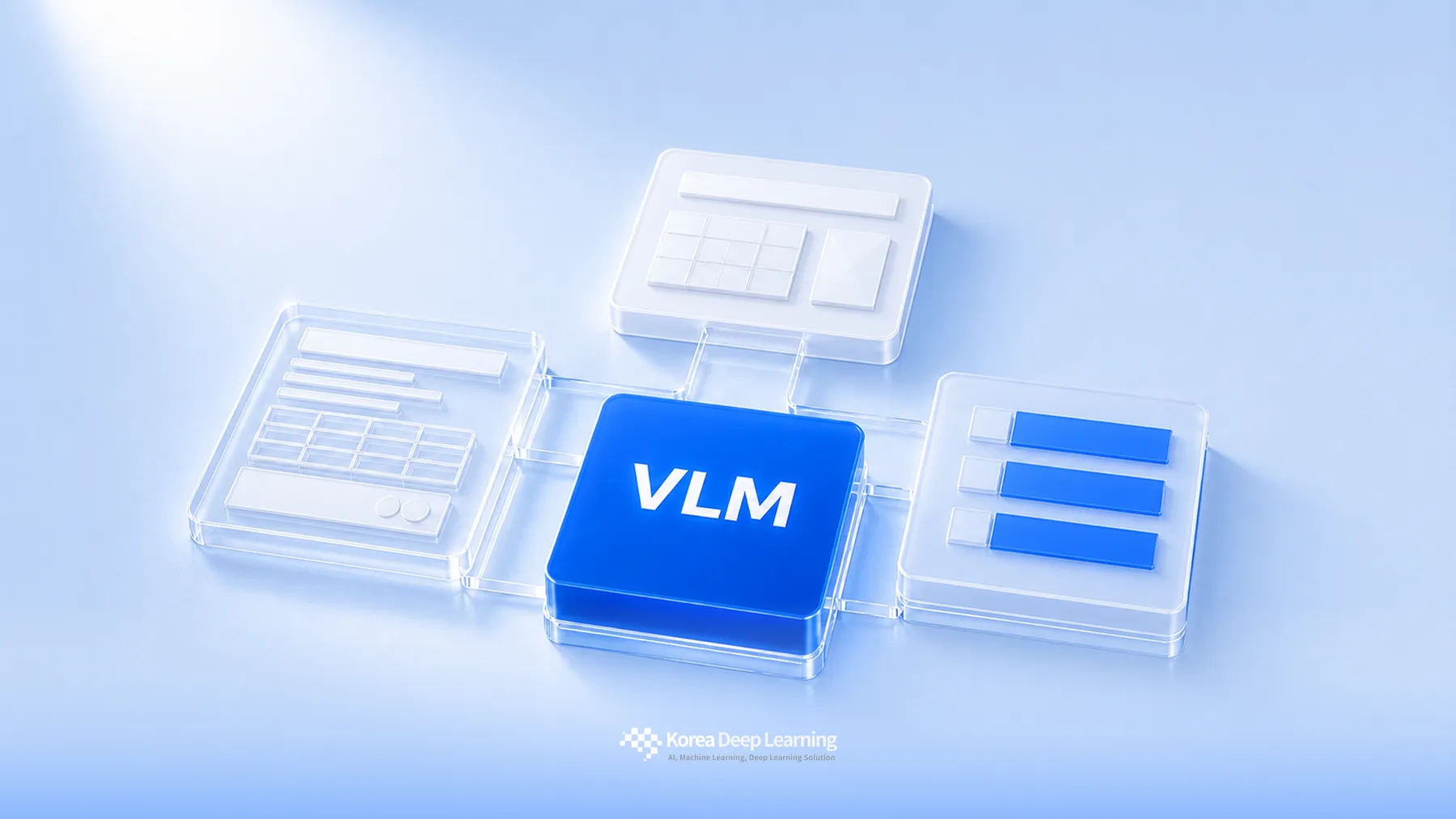
Korea Deep Learning (KDL), founded in 2019, is an enterprise AI agent company. Built on KDL Frontier, its own vision-language model (VLM) specialized for documents, KDL makes AI agents that take on and complete the document work of businesses and public institutions. Its main products are DEEP OCR, DEEP Parser, DEEP Agent and DEEP Ops.