


Op-ed
With the limits of generative AI exposed, businesses choose realistic automation with document AI
Korea Deep LearningPublished

Kim Ji-hyun, CEO of Korea Deep Learning, contributed "With the limits of generative AI exposed, businesses choose realistic automation with document AI" to AI Times.
Why generative AI stalls in front of documents
The piece starts from the reality businesses have faced since the generative AI boom. Many businesses are trying to automate document work with generative AI, but a problem is coming to light: AI cannot accurately read the flow of paragraphs or the relationships inside tables in documents that have already been written. General-purpose generative AI, which produces plausible answers, is hard to put straight into core work because of hallucinations, cost and verification issues.
Kim traces the cause to the way large language models work. A probability-based model fills in the blanks by inference when information is incomplete or the document structure has broken down, and this leads to hallucinations.
"In the end, the heart of the problem is not the size or performance of the model but what the AI is reading."
— Kim Ji-hyun, CEO, Korea Deep Learning
What is needed is document structuring
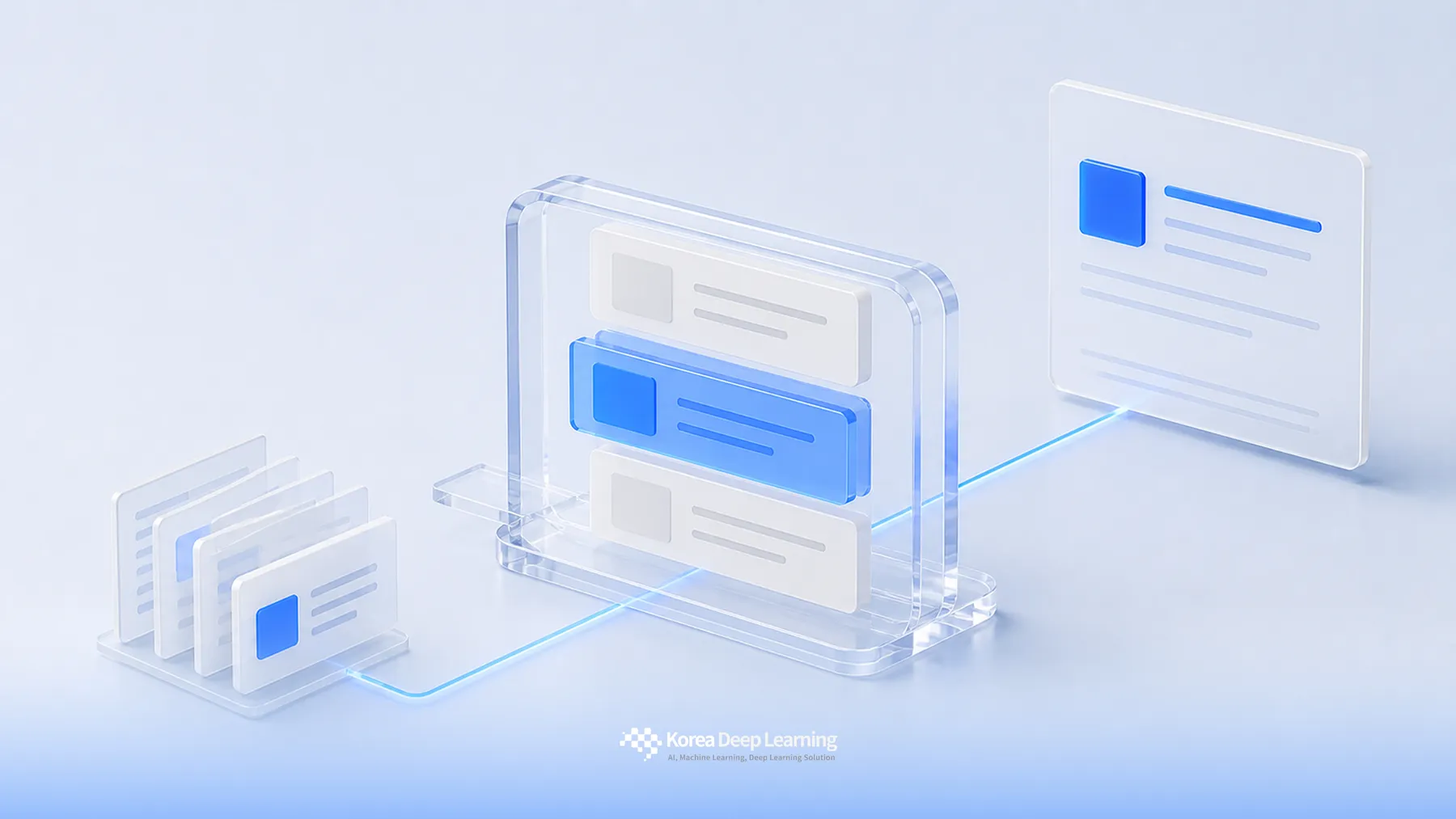
The answer is not to rewrite documents. Kim points out that it is not that staff create wrong documents, but only that AI cannot read documents the way people do. What comes first is document structuring, which restores the structure of existing documents and the relationships between their items. If documents are not read properly, automation is out of reach, and a paradox arises in which people have to check the AI's results all over again.
In this respect, the piece argues, document AI is the area of automation with the clearest return on investment, because its inputs and outputs are clear and its effects can be measured. It also points out that for institutions where security matters, such as in finance, the public sector and healthcare, on-premises structuring that keeps documents from leaving the organization is essential.
Documents are the base data for AI judgment
The piece concludes that documents are no longer files kept for storage but have become the base data for AI judgment. The accuracy of enterprise AI starts with the ability to read documents.
"If it cannot read properly, it cannot judge properly. An error by AI is an error by the business."
The full piece was published in AI Times.
About Korea Deep Learning
Korea Deep Learning (KDL), founded in 2019, is an enterprise AI agent company. Built on KDL Frontier, its own vision-language model (VLM) specialized for documents, KDL makes AI agents that take on and complete the document work of businesses and public institutions. Its main products are DEEP OCR, DEEP Parser, DEEP Agent and DEEP Ops.