

Op-ed
2026 New Year's message declares a shift to non-typing document work
Korea Deep LearningPublished

In a 2026 New Year's message, Kim Ji-hyun, CEO of Korea Deep Learning, declared a shift to "non-typing" document work. The goal is to use generative AI OCR to automate repetitive data entry, classification, verification and follow-up processing in a single flow, and so cut back the repetitive document work people have been doing.
A market where accuracy alone no longer sets you apart
Kim said the performance of OCR based on VLMs and LLMs is quickly converging at a high level. Because it is now hard to stand out on accuracy alone, Kim explained, the market has moved toward minimizing human involvement by connecting verification, post-processing and integration so that results can go straight into business systems.
"The performance of optical character recognition (OCR) technology based on vision-language models (VLMs) and large language models (LLMs) is quickly converging at a high level. Now that it is hard to stand out on accuracy alone, the trend is to minimize human involvement by connecting verification, post-processing and integration so that results can be used directly in business systems."
— Kim Ji-hyun, CEO, Korea Deep Learning
PoCs got easier, but operations got harder
Kim pointed out that proofs of concept (PoCs) have become easier while operations have become harder. Demos and pilots move faster now, but once real operations begin, permissions, security, auditing, quality management and exception handling turn into bottlenecks. Public institutions, financial firms and large companies in particular need evidence and controllable automation, meaning verification logic, logs and access control, more than the simple fact that "the AI read it." Kim predicted that companies that build these operating requirements into their products will gain the upper hand in the OCR industry.
The same thinking is behind Kim's choice of document AI as the area of automation with the highest return on investment (ROI). Document work has clear inputs and outputs and a lot of repetition, so once it becomes "document work with no data entry," the savings show up right away. Kim expects that in 2026, strategies that go deep into specific lines of work, such as lending, insurance, settlement, customs clearance, tax and civil petitions, and prove results there will gain ground over general-purpose document AI.
Plans for 2026: stable extraction and built-in verification
This year, Korea Deep Learning will advance its generative AI OCR, with a focus on stable extraction across many document types through an understanding of document structure. The main planned updates are "built-in verification," with rule- and evidence-based checks; "expanded integration packages," with templates for connecting to customer systems such as ERP, groupware and databases; and "wider public sector and enterprise adoption," with security, permission and audit requirements built in by default.
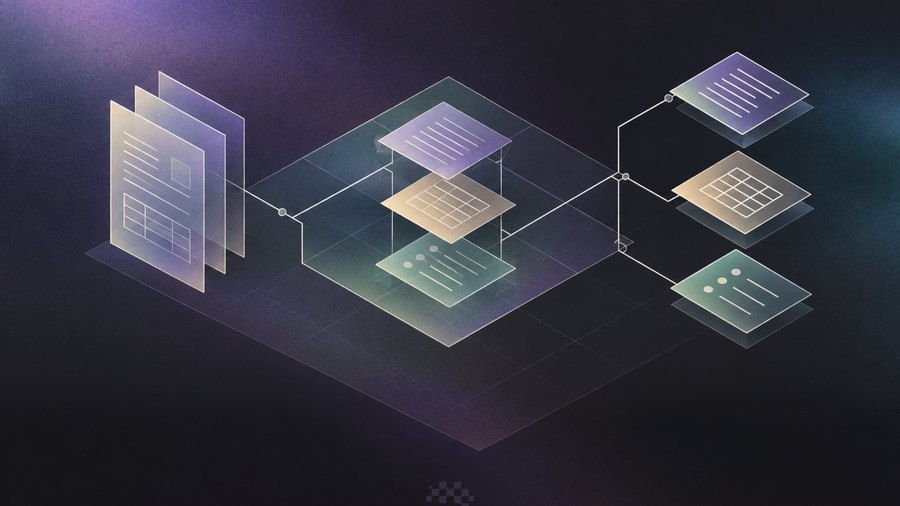
The underlying technologies are DEEP OCR and DEEP Parser, which make up DEEP Agent. DEEP OCR delivers 99% recognition accuracy and processes 780 pages per minute, even on low-quality scans and distorted images, and it automatically splits and classifies files that combine 46 types of forms. DEEP Parser recognizes text, tables and images to analyze document structure, converts even nested tables and merged cells into HTML, and has recorded an average PoC completion time of three days and an API integration success rate of 99.3%.
"Conventional OCR is technology that reads characters. The generative AI OCR that Korea Deep Learning focuses on is technology that finishes the work. In the field, more time goes into what comes after reading a document, such as organizing fields, checking rules, entering data into systems and handling exceptions. We will connect those steps with document AI agents and cut back the repetitive document work people have been doing."
Kim Dong-hyun, head of the Future AI Strategy Team, explained that automation stalls in the field not because the models fall short but because the constraints and criteria that make the work run, such as schemas, permissions and verification, are missing. Kim Ji-hyun said that in 2026 the company would make a noticeable cut in working time, reduce errors and boldly do away with cumbersome document work. The full message was published in AI Times.
About DEEP OCR
Korea Deep Learning started out by reading documents. Built on KDL's own document-specialized VLM, DEEP OCR is Korea's first VLM-based OCR solution, reading not just the characters but the structure and meaning of a document together. It handles unstructured documents in every kind of layout without building separate training data, and extracts text and key-value data from visual elements such as seals, signatures, tables, numbers and symbols. From loan documents in finance to administrative documents in the public sector and handwritten waybills in logistics, documents people used to copy out by hand become business data through DEEP OCR. More information is available on the DEEP OCR page at koreadeep.com.
About DEEP Parser
For AI to work, documents first have to be data. DEEP Parser is a document structuring solution that turns unstructured documents AI struggles to handle directly, such as HWP and PDF, into structured data. It analyzes the meaning and structure of a document together, down to tables, charts, hierarchies and merged cells, to build a knowledge database that RAG and AI agents can use. It was proven in the public sector by structuring administrative documents for the Gyeonggi Provincial Government's generative AI platform, and ranked first overall in the VLM category of ParseBench, a global document parsing benchmark. More information is available on the DEEP Parser page at koreadeep.com.
About DEEP Agent
Korea Deep Learning makes AI that does not stop at reading documents. DEEP Agent is a document-based AI agent that interprets a document's visual structure and linguistic meaning together to extract the key information, then carries out the whole of the document work, from classification and verification to the hand-off into business systems. Upload a contract and it summarizes the key clauses, flags the risky ones and goes on to register it in the ERP, and it reaches the field in two weeks on average with no separate training. It holds GS Certification Grade 1, Korea's national software quality certification, and is designated for priority purchase by public institutions. More information is available on the DEEP Agent page at koreadeep.com.
About Korea Deep Learning
Korea Deep Learning (KDL), founded in 2019, is an enterprise AI agent company. Built on KDL Frontier, its own vision-language model (VLM) specialized for documents, KDL makes AI agents that take on and complete the document work of businesses and public institutions. Its main products are DEEP OCR, DEEP Parser, DEEP Agent and DEEP Ops.