

Technology and architecture
LLM OCR Explained: The Structure and Limits of Reading Documents with Large Language Models, Complete Guide
KDLPublished
LLM OCR is a document recognition method in which a large language model takes text read by OCR or a document image, uses context to read or correct characters, and organizes the required fields into a set format.
Why LLM OCR Is Attracting Attention
Because you do not have to write rules for each form.
Traditional OCR-based document processing required position rules or templates for each form to find which value belonged to which field after the characters were read. Changing the issuer's layout meant rewriting the rules, and an unfamiliar form had to be entered by hand.
Because a large language model understands context, it can find items on an unfamiliar form from an instruction alone, such as "find the contract amount and the contract period." Blurred characters and abbreviations can also be corrected using the surrounding sentences.
Because of this convenience, attempts to attach large language models to document recognition have grown quickly. However, a large language model is a model that produces the most plausible sentence, not one that copies the characters in an image. Before using it on the job, you need to examine how this property shows up in the results.
Precise Definition of LLM OCR: How It Differs from OCR
OCR and LLM OCR, Three Axes of Difference
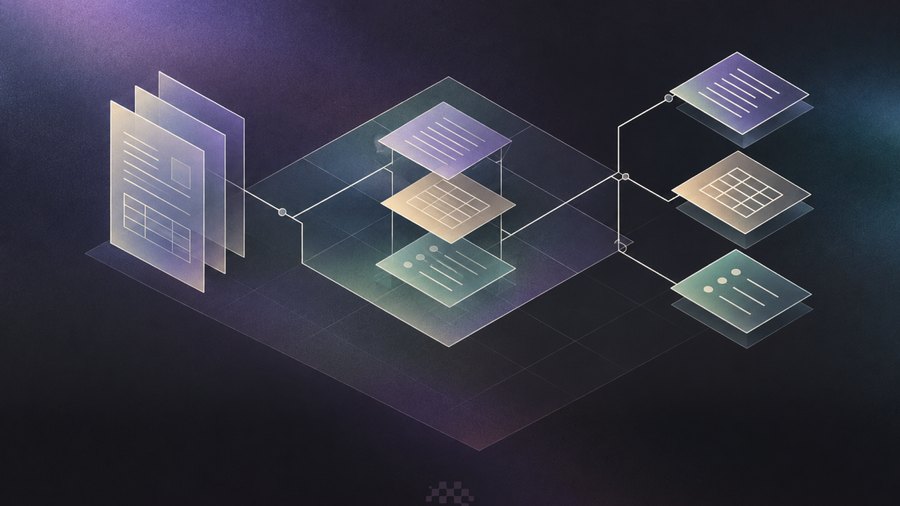
LLM OCR is used in two forms. In one, a large language model receives text read by an OCR engine and corrects and organizes it. In the other, a model that takes images as input reads the document directly and produces the result. A model that reads images directly is classified as a VLM by technology category, but it shares the trait that a language model generates the result.
First, the way results are produced differs. OCR finds the characters in the image and copies them as they are. LLM OCR generates the most plausible sentence from its input, so values that are not in the source can appear mixed in naturally.
Second, location information differs. OCR returns coordinates for each character, so you can see immediately where a result came from in the original. LLM OCR often returns only text, so it is hard to trace where a value came from.
Third, the range of context used differs. OCR judges character by character, so the sentences before and after barely affect recognition. LLM OCR actively uses context to correct blurred characters and interpret the meaning of items, but for the same reason it can fill unreadable parts with guesses.
In short, OCR is strong at verifiable reading, and LLM OCR is strong at interpretation and organization. In practice, many deployments split the roles and use both, rather than choosing one.
Five Conditions for Using LLM OCR on the Job
Five Conditions for LLM OCR in Production
First, each result must have a traceable source location. Each extracted value should be linked to the region of the original image it came from, so that reviewers can compare quickly.
Second, unread values must be left blank. Design the instructions and output format so that uncertain items are left empty or marked as needing confirmation, rather than filled with plausible guesses.
Third, the output format must be fixed. Set item names, data types, and rules for dates and amounts in an extraction schema, so that downstream systems can accept the results as they are.
Fourth, cross-validate using a different method. Compare against OCR results that return coordinates, or against calculation rules such as totals, and pick out the values that disagree.
Fifth, it must be installable in your operating environment. For organizations that cannot easily send documents containing personal information to external models, first check whether the model can be installed internally.
Practical Application of LLM OCR
Separate Reading from Interpretation in the Layout
Sections where characters and numbers must be transcribed exactly go to a recognition model that returns coordinates. The large language model goes in the section that interprets the read text, finds the items and aligns the format. For items where one wrong character causes an incident, such as an amount or an account number, do not use the generated result as it is. Compare it against the reading result.
Write Exception Rules Together with the Extraction Criteria
The instructions should include not only the items to find but also rules for what to do when a value is missing or unreadable. For example, leave a signature field blank if it is empty, or return both amounts if two different amounts are written. Without exception rules, the model tends to fill blanks with plausible values.
Verify by Comparing Before and After with Real Documents
Before adoption, collect real business documents and answer data, and measure accuracy for each item. Measure separately, apart from character-level matches, how often values that are absent from the source appear, since that is the real risk of LLM OCR. Each time the model or the instructions change, measure again on the same documents.
LLM OCR in the Korean Context
Korean finance and public documents contain many personal identifiers, such as resident registration numbers and account numbers, and under network separation regulations, external model APIs are often hard to use. For this reason, a setup that handles both reading and interpretation with an internally installed model is common.
Performance should be checked separately for the forms that often appear in Korean business documents: Korean handwriting, seals, older forms that mix in Chinese characters (Hanja), and low-resolution fax copies. Performance a general-purpose model shows on English documents does not necessarily carry over to Korean business documents.
Frequently asked questions
Are LLM OCR and VLM the same thing?
They overlap. A VLM is a type of model that processes images and language together, while LLM OCR refers to a way of producing document recognition results with a language model. LLM OCR that reads images directly mostly uses a VLM.
Does LLM OCR replace existing OCR?
It is closer to dividing roles than to replacement. OCR is used for sections that need accurate reading with coordinates, and large language models are used for sections that need interpretation and organization.
How is hallucination prevented?
Instruct the model to leave unread values blank, review results by linking them to their original positions, and cross-validate against readings from different methods. A single model's performance alone cannot fully prevent it.
Can it handle unfamiliar forms?
Finding items without a template is the strength of LLM OCR. However, for unfamiliar forms, it is safer to start with a higher share of human review.
Can it read handwriting?
It can, but accuracy varies greatly with the model and the writing condition. For work with a lot of Korean handwriting, measure with real documents first.
Can I use an external API?
If the documents contain no personal information or trade secrets, yes. For regulated sectors such as finance and the public sector, first review an internally installed setup.
Can I put the results directly into business systems?
It is better to feed automatically only the values that pass format validation and cross-validation, and to split the flow so that values failing the criteria are reviewed by a person.
Send a sample and the fields to extract, and we will map where LLM OCR applies and where results need checking.
Contact us