

Adoption and operations
What Is DEEP Ops? The Platform for Changing, Validating and Managing Document AI, Explained Completely
KDLPublished
DEEP Ops is a document AI operations platform from Korea Deep Learning, designed so that the extraction criteria of document AI can be changed to fit changes in work, the performance before and after a change can be validated, and versions and operating history can be managed.
Document AI Becomes Harder to Manage in Operation Than to Build
Document automation works best when it is first built.
That is because the system was built to match the document forms, extraction items and business criteria of that time. But the real work environment does not stay the same.
Insurance screening criteria change, and a new item may need to be checked on an existing diagnosis. A financial institution revises its application form, or a public institution changes its laws and notices, and the extraction criteria shift accordingly.
With the old approach, even a small change can mean sending a modification request to the vendor, preparing the data, modifying the model or system, then validating and deploying again, over and over. The change itself is simple, but the process of applying it becomes long.
DEEP Ops focuses on treating document AI not as a system built once and finished, but as an operational asset that can be continuously managed to match real changes in work.
The Precise Definition of DEEP Ops: What It Operates
Managing the Change Criteria and Validation Process of Document AI
The core of DEEP Ops is not simply deploying an AI model.
In real document work, what matters is which items to extract, which conditions to apply, whether the changed criteria produce better results than before, and whether a change applied to operations can be rolled back.
In DEEP Ops, the items or conditions to be newly extracted from documents can be defined in natural language, and the changed results can be checked on actual documents.
The current criteria and the newly created criteria can also be applied to the same documents and their results compared. The approach is to look at extraction results by item, accuracy and processing delay together, and confirm whether the change led to a real improvement.
Changes are managed by version. It records what changed and when, lets you check the differences from the previous version, and makes it possible to return to an earlier version when needed.
In short, DEEP Ops can be seen as a platform that manages the flow of document AI from change to evaluation, approval, operation and history as a single operating flow.
The Four Functions That Make Up DEEP Ops
First, Changing Extraction Criteria in Natural Language
Work staff can define, in natural language, the items and conditions that need to be checked newly in documents.
For example, if the work previously extracted only the claim amount and contract number, but the new business criteria require checking a particular date or screening item as well, you can define new extraction criteria and check the results.
Not every change requires retraining the model. In areas where changes can be made by adjusting the extraction criteria and the schema rather than changing model parameters, the change can be applied without a separate training project.
Second, Comparing Performance on the Same Documents
Putting a change into operation right after making it is risky.
DEEP Ops lets the previous version and the new version be applied to the same evaluation documents and their results compared.
You can look at extraction results by document and by item, not just the overall results, and judge whether the new criteria actually improved things by comparing accuracy, processing results and latency.
This makes it possible to confirm the before-and-after effect of a change through the results of the same test conditions, rather than by someone's sense.
Third, Version and Change History Management
In operating document AI, knowing what changed in the past matters as much as knowing what is currently applied.
DEEP Ops records changes to extraction items and conditions by version.
You can compare how a new version differs from the existing one, and if a problem is found after operation, you can return to the previous state.
It is also important for operations that the record shows which criteria changed, when and for what reason, even when the staff responsible changes.
Fourth, Building Document Work Workflows
Document work does not end with extracting information.
Documents must be taken in and classified, the required information extracted, different values cross-checked or calculated, and the next step handled differently depending on conditions.
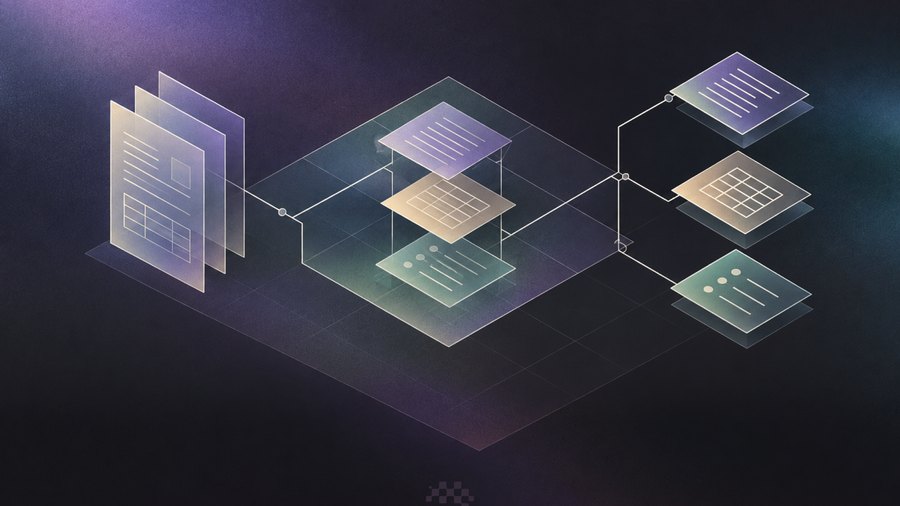
DEEP Ops links the steps from document intake and OCR through classification, information extraction, value cross-checking and calculation, conditional branching, to judgment and generation of results, so that a workflow can be set up for each task.
As a result, the management scope extends beyond individual models to how document AI actually works within the business.
How to Apply DEEP Ops in Practice
When Work Criteria Change, Start with the Extraction Criteria
Suppose that the work previously checked three items, A, B and C, in documents, but a new regulation requires adding item D.
First, define the new extraction item and conditions.
At this point, record clearly which field is to be extracted and on what basis. Simply adding an item name is not enough. Managing the value format and exception conditions together makes the change history easier to understand later.
Compare Against the Same Documents as the Existing Version
Compare the changed criteria against the existing version using the same evaluation documents.
Check whether the new item is extracted correctly, and whether the performance of items that were extracted well before has declined.
If only the one item you changed improves while errors rise in other items, the change is hard to put into operation directly.
Only a comparison under the same conditions lets you judge the effect of a change accurately.
Put Only Validated Versions into Operation
When the evaluation results meet the criteria, put the new version into operation.
In environments where internal control over changes matters, such as finance or the public sector, you can separate reviewers from approvers and record which version was applied to operations and when.
Be sure you can return to the previous version if a problem occurs.
Doing this makes changes to document AI a managed operating process rather than a one-time fix.
Manage the Work Flow Too
Extracting values well from documents alone does not complete the automation of the work.
For example, when processing an application, you may need to check the document type, extract the required items, compare values with other documents, or route the case to approval or review depending on conditions.
In DEEP Ops, these follow-up steps can be configured as a work flow, so that the results of document AI carry through to actual work processing.
DEEP Ops and MLOps
MLOps is a methodology that systematizes the training, deployment, version management and performance monitoring of machine learning models in general.
Its central objects include training data, models, experiment results and model versions.
DEEP Ops focuses more concretely on the actual operation of document AI.
In document work, not only the model weights but also the extraction items, schemas, natural-language instructions, evaluation documents, business criteria and workflows directly affect operating results.
DEEP Ops is therefore less a replacement for general MLOps than a platform that covers the operating areas document AI needs in order to respond to real changes in work.
DEEP Ops and VLMOps
VLMOps refers to the concepts and operating structure for continuously running vision-language models in real work environments.
Its core is managing extraction criteria, schemas, evaluation criteria, versions and change history, so that document AI keeps working as work changes.
DEEP Ops is the operations platform from Korea Deep Learning that implements these document AI operating concepts so they can be carried out in actual work.
Put simply, VLMOps describes the method and structure of operation, while DEEP Ops is the product that actually performs that operation.
DEEP Agent and DEEP Ops
DEEP Agent and DEEP Ops play different roles.
DEEP Agent focuses on the role of reading and classifying actual documents, extracting and validating the required information, and carrying out the work.
DEEP Ops is the operating area that changes the document AI once built to match changes in work, validates the performance of new criteria, and manages versions and change history.
If DEEP Agent is the AI Worker that carries out document work, DEEP Ops can be understood as the operating environment that keeps that Worker performing well as the work changes.
Document AI Operations in Domestic Finance and the Public Sector
In finance and the public sector, document forms and business criteria are not fixed.
Laws and notices are revised, internal screening criteria change, and new applications and certificates may be added.
Work changes sometimes happen at a scheduled time, and sometimes arise because documents not expected during operation come in.
If every change must be handled as a new development project, a gap can open between the speed at which work changes and the speed at which the AI system responds.
In document AI operations, it matters not only how accurate the system was when first built, but also how quickly its criteria can be revised and validated, and how soon it can go back into operation when the work changes.
Frequently asked questions
What does DEEP Ops do?
It is an operations platform that manages extraction criteria and changes to the work after document AI is adopted. It supports changing criteria in natural language, comparing performance before and after a change, version management, and building work workflows.
If the document form changes, does the model have to be retrained?
Not every change requires retraining. Many changes can be handled by adjusting extraction items, conditions or the schema without training the model anew. However, if the model's own recognition ability needs improving, separate training may be needed.
How can I confirm that a changed criterion is better than before?
Apply the existing version and the changed version to the same evaluation documents and compare the results by document and by item along with the performance metrics. Also confirm that items that were handled well before have not declined.
Can I roll back if I change something wrongly?
You can manage version-by-version change history, compare with the previous version, and return to the existing version when needed.
How is DEEP Ops different from MLOps or VLMOps?
MLOps and VLMOps are concepts that describe how operation is done, while DEEP Ops is the product that implements that approach. VLMOps in particular is a principle of treating the extraction criteria of a document vision-language model as an asset, and DEEP Ops is the screens and procedures built so that work can be carried out in line with that principle.
How many people need to run it after adoption?
Because criteria are defined in natural language, you do not need dedicated staff to handle the model. Staff who know the work can revise the criteria, and a configuration in which the decision to apply changes to operation is managed through an approval process is common.
Is it used together with DEEP Agent?
DEEP Agent reads, classifies, extracts and validates documents and carries out the work, while DEEP Ops handles changes, validation, version management and operation after construction. The two products take on different roles, execution and operation, of document AI.
Which work needs DEEP Ops the most?
It is especially useful in work where document forms or extraction criteria change often. Typical examples are insurance screening, financial application processing and public-institution document work, where laws, regulations and business criteria change frequently.
Do not rebuild document AI every time work criteria change. With DEEP Ops, you can manage the change criteria, validate them on the same documents, and then put them into operation.
Contact us